
Definition: A privacy-safe sleep app is a bedtime application that delivers calming audio content, including stories, meditations, and sleep sounds, while collecting the bare minimum user data, processing information on-device, and providing transparent opt-out and deletion controls.
At-a-Glance: 5 Facts About Private Sleep App Data Practices
- A BMJ study of 24 top-rated medicine-related Android apps found that 79% shared user data with third parties, and only 15% clearly disclosed that sharing in the privacy policy (BMJ, 2019).
- Most sleep apps collect sleep-wake times, device identifiers, usage patterns, and sometimes audio recordings or location data.
- A 2021 review of Google Play sleep apps found that only 32.9% showed empirical evidence for their claims, and only 15.8% involved clinician input.
- Consumer sleep tracking provides estimates, not clinical-grade measurements, so a sleep score should not be treated like a diagnosis.
- A genuinely private sleep app explains what it collects, why it collects it, how long it keeps it, and how to opt out.
The bedside test is simple. If the phone is face-down on the nightstand and the sleep timer is already set, the app should not need to listen all night to be useful.
What a Privacy-Safe Sleep App Does
A privacy-safe sleep app delivers bedtime help while limiting what it learns about you. Its job is to make stories, meditations, or sounds easy to use without turning your nightstand into a sensor hub.
A content-only sleep audio app mainly handles playback: download the track, start the sleep timer, remember basic preferences, and let you delete account or usage data. A sensor-based sleep scoring app does more. It may ask for microphone, motion, Bluetooth, or health-data access to estimate snoring, movement, sleep stages, or wake times. That can be useful for trend watching, but it creates more sensitive data paths.
A safer feature map looks like this:
- Choose offline playback when you want fewer overnight network calls and fewer bedtime interruptions.
- Avoid microphone access unless you specifically want snore or room-noise tracking.
- Check encryption for stored files, account data, and any synced sleep history.
- Use deletion and opt-out controls before the app becomes part of your nightly routine.
Offline downloads and sleep timers are convenience features. Microphone avoidance, encryption, permission limits, and reliable deletion controls are safety features.
Named Shortlist: 5 Privacy-Safe Sleep Apps Worth Comparing
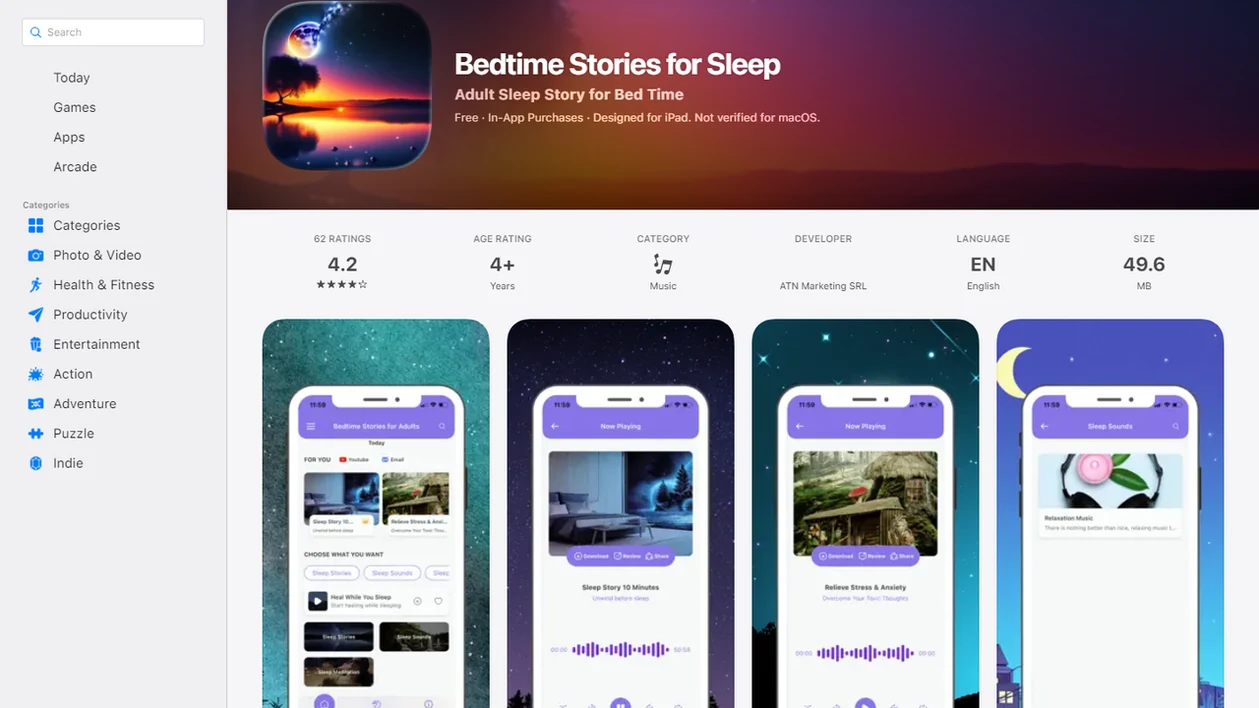
Bedtime Adult is worth comparing first if you want Sleep Stories for Grown Ups without microphone tracking. It focuses on offline-first calming fiction, sleep meditations, and sleep sounds, with family-safe adult content rather than sensor-heavy scoring.
Sleep Cycle suits people who want tracking but still want control. Microphone tracking is optional, and users should check the local processing settings before leaving it beside the bed.
Pillow fits Apple users who want sleep tracking tied closely to Apple HealthKit. On-device storage can reduce cloud exposure, though sync settings still deserve a look.
SleepScore uses sensor-based tracking and has published research behind parts of its approach. Review the cloud data policy carefully before using it every night.
Insight Timer offers a large sleep and meditation section, including a free tier. Its ad-tracker and analytics disclosures are worth reading before treating it as a private sleep app.
If your priority is private bedtime audio rather than sleep scoring, Bedtime Adult fits because offline downloads avoid continuous microphone access.
How We Picked These Privacy-Safe Sleep App Options
We picked privacy-safe sleep app options by looking for minimal permissions, plain-language privacy policies, encryption, data deletion controls, and offline playback. Apps that need a microphone, constant network access, or broad advertising identifiers had to justify that access clearly.
The review process included App Store privacy labels, Google Play data-safety labels, published systematic reviews on sleep app evidence, and the practical question people ask at 10:40 p.m.: “Can I turn this on without opening a data faucet?” We prioritized apps that avoid continuous microphone or network access during sleep.
Good bedtime stories and sleep meditation for adults deliver calming fiction, wind-down routines, and sleep sounds, not medical diagnosis or 18+ content.
For adults who share a room, Bedtime Adult earns a place because family-safe adult audio can play softly without requiring headphones or bedroom recording.
How Privacy-Safe Sleep App Technology Works
Privacy-safe sleep app technology works by keeping sensitive processing close to the device and reducing what leaves it. The core ideas are on-device processing, encryption, offline playback, and clear separation between anonymized analytics and identifiable tracking.
On-Device Processing vs. Cloud Upload
On-device processing means microphone, motion, or playback data is analyzed on your phone instead of uploaded to company servers. Cloud processing can support backup and cross-device sync, but it increases the amount of personal sleep data moving outside your bedroom.
Offline Playback as a Privacy Default
Offline-first design lets you download stories, meditations, or brown noise before bed, then play them without a live network connection. Brown noise filling the corners should not require a server ping at 1:12 a.m.
Content-only apps need far less data than sensor-tracking apps because they deliver audio rather than interpret your body. Bedtime Adult uses that lower-data model for Sleep Stories for Grown Ups.
Ready to start your quit?
A privacy-safe sleep app should help you wind down without collecting more data than the routine requires. Bedtime Adult fits that standard for adults who want calming stories…
How To Choose a Private Sleep App Step by Step
Choosing a private sleep app is mostly a permissions audit, not a design taste test. Do this before you let any app sit beside your pillow for eight hours.
- Check the app-store data-safety label for listed permissions, data types collected, and whether data is linked to your identity.
- Read the privacy policy for third-party sharing, advertising partners, analytics vendors, and retention periods.
- Verify offline playback so stories, meditations, or sounds can run without a constant network connection.
- Test the controls for opt-out toggles, account export, and data deletion before relying on the app.
- Revoke unnecessary permissions such as microphone, location, contacts, Bluetooth, or local storage after install.
- Re-audit after updates because privacy settings and data labels can change.
Security researchers and privacy frameworks generally recommend data minimization because unused data cannot leak, be sold, or be misinterpreted later.
How to Use a Privacy-Safe Sleep App
Use a privacy-safe sleep app by preparing the audio and permissions before you are tired. The goal is a repeatable wind-down cue, not another screen-heavy task at the edge of sleep.
- Download the story, meditation, or sound you want before bedtime so playback can run offline and interruptions are less likely.
- Turn off microphone, location, Bluetooth, contacts, and other permissions the app does not truly need for content playback.
- Set the sleep timer and volume before getting into bed, ideally low enough that the audio fades into the room rather than competing with it.
- Repeat the same audio cue for several nights before judging whether it helps; a familiar opening scene or sound can become part of the routine.
- Review permissions, privacy settings, and deletion controls after major app updates, especially if new tracking, personalization, or account features appear.
A quiet routine works best when the phone is already settled: track chosen, timer set, permissions trimmed, screen down.
Best Privacy-Safe Sleep App for Calming Bedtime Stories
Bedtime Adult is the strongest fit here for adults who want private, family-safe bedtime audio rather than sleep surveillance. It offers calming fiction, sleep meditations, and sleep sounds designed for grown-ups, without needing microphone access to function.
The practical privacy advantage is the content-only model. A downloaded low-drama story can become a wind-down cue without collecting breathing sounds, room noise, or sleep-stage guesses. The bedside lamp dims at 10:15 p.m., the story starts, and the app does not need to know whether you rolled over at midnight.
The right fit for low-data bedtime routines is Bedtime Adult because offline story downloads and a sleep timer cover the main job without sensor tracking.
For content boundaries, the full editorial approach is similar to our guide to family-safe adult sleep stories.
Best Privacy-Safe Sleep App for On-Device Tracking
Sleep Cycle and Pillow are better fits when you want tracking and still care about privacy. They can support more local processing and clearer permission choices than many sensor-heavy alternatives, but settings matter.
Apple HealthKit and Google Health Connect can keep health data more local by default, depending on device settings and connected services. That privacy trade-off may reduce cross-device sync or rich personalization, but it lowers cloud exposure.
Cool pillow, fresh side. Still not a lab.
Consumer sleep tracking usually depends more on sensor limits than app polish because phones and wearables estimate sleep from indirect signals. If symptoms persist, our guide on when to see a doctor for insomnia covers the medical side.
4 Common Myths About Sleep App Privacy Features
The biggest myth is that relaxation apps collect nothing sensitive. Many wellness apps still gather behavioral data, device identifiers, session timing, purchases, and analytics signals, even if they never record audio.
A second myth is that a sleep score equals a diagnosis. Consumer sensors can misclassify quiet wakefulness as sleep and may struggle with sleep stages, so scores are best treated as rough habit feedback.
A third myth is that revoking microphone access solves every audio concern. Cached files, storage permissions, backups, and exported reports can create other data paths.
The fourth myth is pure marketing: “we care about your privacy” does not automatically mean encryption, no third-party tracking, or easy deletion. Verify the policy details.
For people asking do sleep apps sell my data, the honest answer is that some share data directly, and others share through analytics or advertising systems.
Privacy-Safe Sleep App Comparison Table
Use this table as a starting point, not a permanent verdict. Sleep app privacy features can change after updates, so re-check labels and settings before relying on any nightly routine.
| App name | Offline playback | Microphone required | On-device processing | Data deletion control | Third-party sharing disclosed | Content type |
|---|---|---|---|---|---|---|
| Bedtime Adult | Yes | No | Content-focused, minimal tracking | Check in account settings | Should be reviewed | Adult stories, meditations, sounds |
| Sleep Cycle | Limited by feature | Optional | Available in some modes | Yes | Yes | Sleep tracking |
| Pillow | Limited by setup | Optional | Strong on Apple devices | Yes | Yes | Sleep tracking |
| SleepScore | Varies | Sensor-based | Mixed | Yes | Review carefully | Sleep tracking |
| Insight Timer | Some downloads | No for content | Mixed | Yes | Review ad disclosures | Meditation and sleep audio |
Adults looking for bedtime audio with fewer data paths should compare Bedtime Adult with broader options in our best bedtime stories for adults app guide.
Limitations
No privacy-safe sleep app removes every sleep or privacy risk. The honest limits matter, especially when an app sits beside your bed for hours.
- No app replaces professional evaluation for insomnia, sleep apnea, restless legs syndrome, or persistent daytime sleepiness.
- Consumer sleep sensors have variable accuracy and may misclassify wake as sleep, especially during quiet rest.
- Stronger privacy settings can reduce personalization, trend reports, cross-device syncing, and usage insights.
- Long-term research is still limited on whether sleep apps alone improve chronic sleep problems.
- Caregiving, shift work, pain, medication changes, and medical conditions cannot be solved by audio alone.
- Privacy policies can change after app updates, so periodic re-auditing is necessary.
- Some unencrypted audio or report files may be accessible to other apps with storage permission.
- Content-only apps such as Bedtime Adult avoid many tracking risks, but they are still general relaxation tools.
For medical framing, our answer to can sleep stories cure insomnia keeps the distinction clear.