
Family-Safe Adult Sleep Stories for Shared Homes
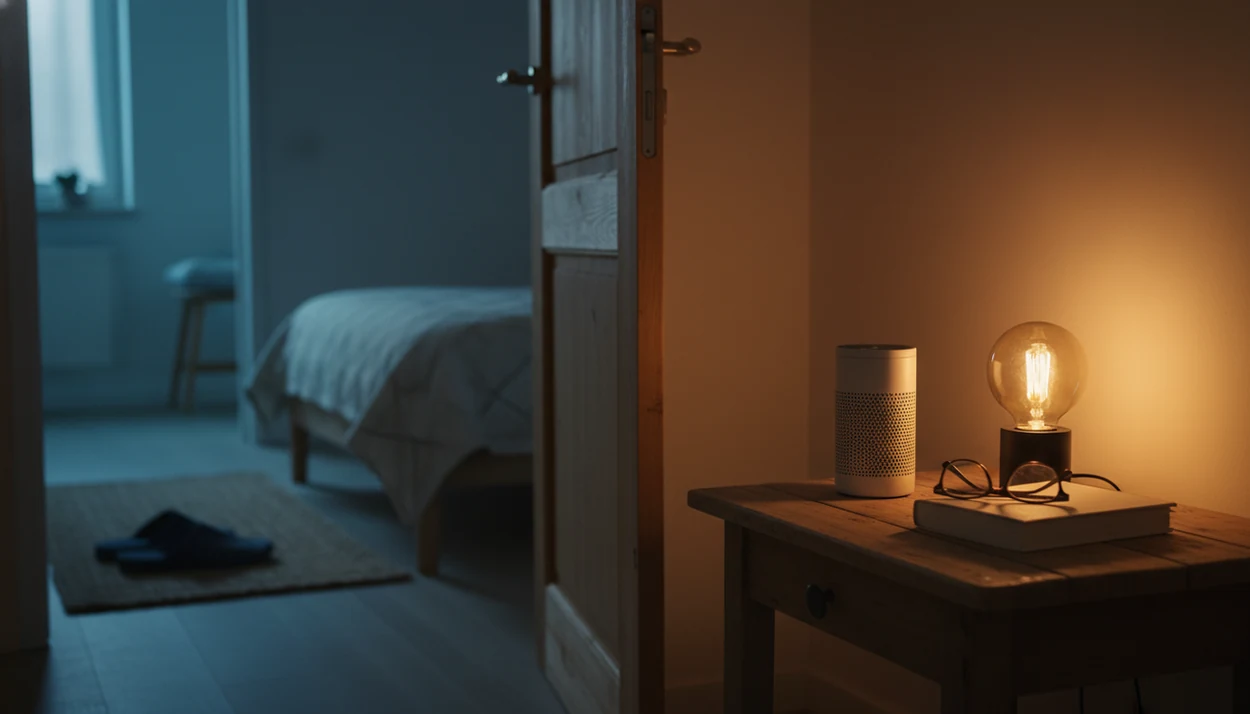
Family-safe adult sleep stories are calming stories for grown-ups that avoid explicit sexual content, erotic roleplay, graphic violence, horror, and startling material, so they are safe to play in shared homes. They are designed for adult relaxation, not children’s entertainment or 18+ content.
> Definition: Family-safe adult sleep stories are non-erotic, low-intensity bedtime stories for adults that use gentle narration, slow pacing, and calm imagery without explicit scenes, horror, or disturbing content.
Safety note: This page is educational and about content safety, not medical diagnosis or treatment. If sleep problems are persistent, worsening, or tied to breathing pauses, severe daytime fatigue, trauma symptoms, or distress, talk with a qualified clinician.
TL;DR
- “Adult” means written for grown-up attention spans and life themes, not explicit or erotic.
- Family-safe standards should exclude sexual detail, fetish content, graphic violence, horror jumps, heavy profanity, and upsetting intensity.
- Sleep stories work best as part of a wind-down routine with dim lights, screen curfews, and consistent bedtimes.
Family-Safe Adult Sleep Stories Content Standard
Family-safe adult sleep stories are grown-up, calming, non-erotic stories that are safe to play at home. “Adult” refers to tone, pacing, and life context, not explicit sexual content.
A good standard should hold up in real rooms. A partner may be falling asleep beside you. A roommate may hear a smart speaker through thin walls. A baby monitor may pick up the first five minutes from the bedroom. The story should still feel appropriate.
Bedtime Adult is a bedtime stories for adults app that offers calming fiction, sleep meditations, and sleep sounds for grown-ups. Tools in this category should make their boundaries easy to understand before anyone presses play. That includes shared homes, partners, roommates, open doors, guest rooms, and speakers that carry farther than expected.
The room is rarely as private as it feels.
5 Facts About Non-Explicit Adult Sleep Stories
- Non-explicit adult sleep stories use slow pacing, gentle imagery, and soothing narration to reduce mental stimulation. The point is to give the mind something quiet to follow, not a plot it needs to solve.
- They exclude explicit sexual content, erotic roleplay, fetish content, and graphic violence. A family-safe label should mean the listener won’t be surprised by 18+ material.
- They work better inside a broader bedtime routine. The American Academy of Sleep Medicine advises turning off electronic devices at least 30 minutes before bed (https://sleepeducation.org/healthy-sleep/healthy-sleep-habits/), so audio-only listening can fit a lower-screen routine.
- They are supportive tools, not a standalone cure for chronic insomnia. For chronic sleep trouble, clinical care matters more than any single story.
- Clear labeling matters because listeners often play them near family, roommates, or children. The National Sleep Foundation’s 2020 Sleep in America Poll found that 84% of U.S. adults said feeling relaxed and free from stress is important for good sleep (https://www.thensf.org/wp-content/uploads/2021/03/2020-Sleep-in-America-Poll-Report.pdf), which helps explain the appeal of low-drama audio.
For shared homes, non-explicit adult sleep stories are often easier than video because they lower visual stimulation and can be played at a controlled volume.
How Family-Safe Adult Sleep Stories Work
Family-safe adult sleep stories work through cognitive off-ramping and sensory predictability. In plain terms, they give your attention a quieter place to land, so rumination has less room to keep looping.
Cognitive off-ramping means replacing work replay, time zone math abandoned on the pillow, or tomorrow’s errands with low-stakes narrative attention. Sensory predictability means the voice stays calm, the scenes stay gentle, and the story avoids sudden conflict. A low narrator voice under the blankets can become a wind-down cue after a few nights.
Audio-only listening can also support a screen-free routine. The AASM advises turning devices off at least 30 minutes before bedtime (https://sleepeducation.org/healthy-sleep/healthy-sleep-habits/), and the CDC reports that about 1 in 3 U.S. adults do not get the recommended 7 hours of sleep (https://www.cdc.gov/sleep/data-research/facts-stats/adults-sleep-facts-and-stats.html). A story does not fix that by itself, but it can make the last part of the evening less stimulating.
Good bedtime stories and sleep meditation for adults deliver calming fiction, wind-down routines, and sleep sounds, family-safe, not 18+.
Safe-to-Play-at-Home Content Boundaries
Safe-to-play-at-home audio needs clear boundaries before bedtime, not vague promises. If a story might play through a shared speaker, an open door, or a guest room wall, the content standard should be obvious.
| Content level | What fits | What should happen |
|---|---|---|
| Allowed | Travel, nature, cozy routines, gentle mystery without peril, reflective fiction, soft meditations | Keep the pace slow and the stakes low. |
| Limited | Mild sadness, weather, calm conflict resolution, very light language if any | Use sparingly and label clearly when mood may feel heavy. |
| Excluded | Explicit sex, erotic tension, fetish content, graphic violence, horror, jump scares, aggressive profanity, disturbing themes | Do not include in family-safe adult sleep stories. |
Household listening has practical friction. A smart speaker in the bedroom may sound louder in the hallway. A child may walk by during the opening scene. A guest may hear the ending through a thin wall. For a deeper content checklist, our guide to safe bedtime stories for adults explains the same boundary in more detail.
Non-Erotic Adult Sleep Stories Versus Children’s Bedtime Stories
Non-erotic adult sleep stories should feel mature without becoming explicit. They can respect adult attention spans while avoiding sexual scenes, graphic content, and childish sing-song narration.
| Feature | Non-erotic adult sleep stories | Children’s bedtime stories |
|---|---|---|
| Audience | Grown-ups winding down | Children preparing for sleep |
| Themes | Travel, nostalgia, work decompression, solitude, nature, reflection | Simple morals, animals, family routines, imagination |
| Tone | Mature, calm, non-clinical | Gentle, playful, often more animated |
| Content limits | No explicit scenes or disturbing intensity | Age-appropriate by design |
A calm adult narrator sounds different from a children’s story voice. The pacing is slower, but the language can still be thoughtful. A story about a late train ride, a closed bookshop, or a quiet coastal walk can feel grown-up without becoming graphic.
Mature does not mean explicit.
Common Myths About Family-Safe Adult Sleep Stories
Myth 1: All adult sleep stories are erotic. Many adult sleep stories are non-erotic and built for general relaxation. “Adult” can mean grown-up subjects, slower pacing, and a narrator who does not sound like children’s media.
Myth 2: Any nighttime audio is automatically bad for sleep. Bright screens and stimulating media are the bigger concern in sleep hygiene basics. Low-volume, calm audio can be part of a screen-light routine for some adults.
Myth 3: Sleep stories cure chronic insomnia. They do not. Clinical guidance treats CBT-I as first-line care for chronic insomnia, and our page on can sleep stories cure insomnia explains that limit directly.
Myth 4: Family-safe means childish. Family-safe stories can still include reflective fiction, travel, solitude, and adult decompression. The goal is low-drama story structure, not cartoons.
Clinicians typically recommend evidence-based care, such as CBT-I, for persistent insomnia rather than relying on relaxation audio alone.
4 Household Scenarios for Safe-to-Play-at-Home Audio
1. A partner falls asleep next to the listener. Keep the volume low enough that a partner can ask, “Can you turn it down one notch?” before the room settles. Set a sleep timer before the story starts.
2. A child overhears through a cracked door or baby monitor. Choose clear family-safe labels and avoid anything with erotic, horror, or graphic tags. Adult sleep stories are not made for children, but overheard content should not be explicit.
3. A roommate or guest hears smart speaker audio. Place the speaker close to the bed, not near the door. Download episodes when possible so the wrong queue does not autoplay from another account.
4. A thin-walled apartment or shared vacation rental changes the rules. Use a lower volume than you would at home, or switch to one earbud if that’s comfortable.
For travel, downloaded stories can keep the routine steady when the suitcase is half-unpacked beside the bed.
Limitations
Family-safe adult sleep stories are relaxation tools, not medical treatment. They may help some adults wind down, but they are not a standalone treatment for chronic insomnia, sleep apnea, restless legs syndrome, trauma symptoms, or other diagnosable conditions.
- Some listeners may become dependent on a specific narrator, app, or story to fall asleep.
- Non-explicit themes can still bother people. Grief, storms, loneliness, or loss may feel too heavy at night.
- Children who overhear a story may react to mood even when the content is non-graphic.
- Audio can disturb partners or roommates if the volume, timer, or speaker placement is wrong.
- Privacy still matters because sleep apps and audio platforms may collect usage data; our sleep app privacy guide covers that concern.
- Persistent insomnia deserves evidence-based care, including CBT-I when appropriate.
- If sleep problems continue, worsening fatigue, breathing pauses, or distress are reasons to learn when to see a doctor for insomnia.
Small tools help. They do not replace care.
When to Seek Professional Sleep Help
Seek professional sleep help when sleep trouble is persistent, getting worse, or starting to affect your days. Sleep stories can support relaxation, but they should stay in the “wind-down aid” category, not become a substitute for diagnosis or treatment.
A clinician can help sort out whether the issue is chronic insomnia, sleep apnea, medication effects, stress, trauma, pain, or another condition. CBT-I is often the first-line care for chronic insomnia when it fits the person and situation. Breathing pauses, gasping awake, or loud snoring are especially important to mention because they can point to medical sleep problems that audio will not solve.
- Track how long the problem has lasted, how often it happens, and whether fatigue, mood, work, driving, or caregiving are affected.
- Notice red flags such as witnessed pauses in breathing, choking or gasping, very loud snoring, or worsening daytime sleepiness.
- Ask a qualified clinician about evidence-based options, including CBT-I for chronic insomnia when appropriate.
- Seek urgent help right away if distress feels severe, you feel unsafe, or sleep loss creates immediate safety concerns.
FAQ
Are adult sleep stories explicit?
Not necessarily. Adult sleep stories can be written for grown-ups without sexual content, erotic roleplay, graphic violence, or disturbing scenes.
What are family-safe sleep stories?
Family-safe sleep stories are non-erotic, low-intensity, non-graphic stories that are safe to play in shared homes. They avoid explicit scenes, horror, harsh profanity, and startling material.
Are family-safe adult sleep stories safe for children to overhear?
Family-safe adult sleep stories are not made as children’s entertainment. However, they avoid explicit or graphic material if a child briefly overhears them.
Can roommates hear sleep stories through a wall or smart speaker?
Yes, roommates may hear sleep stories through thin walls or smart speakers. Use low volume, a sleep timer, careful speaker placement, or headphones when needed.
Do sleep stories help with insomnia?
Sleep stories may support relaxation and reduce bedtime rumination for some adults. They are not a cure for chronic insomnia or a replacement for evidence-based care.
Is nighttime audio bad for sleep?
Low-volume calming audio is different from bright screens or stimulating media. Many adults use sleep stories as part of a wind-down routine, especially with the screen off.
Are non-erotic adult sleep stories childish?
No. Non-erotic adult sleep stories can use mature themes such as travel, nature, solitude, nostalgia, and work decompression without explicit scenes.
Is there an app for family-safe adult sleep stories?
Yes. Bedtime Adult is an app for family-safe adult sleep stories, meditations, and sleep sounds for grown-ups.