
Calming Stories To Fall Asleep Without Intense Plot
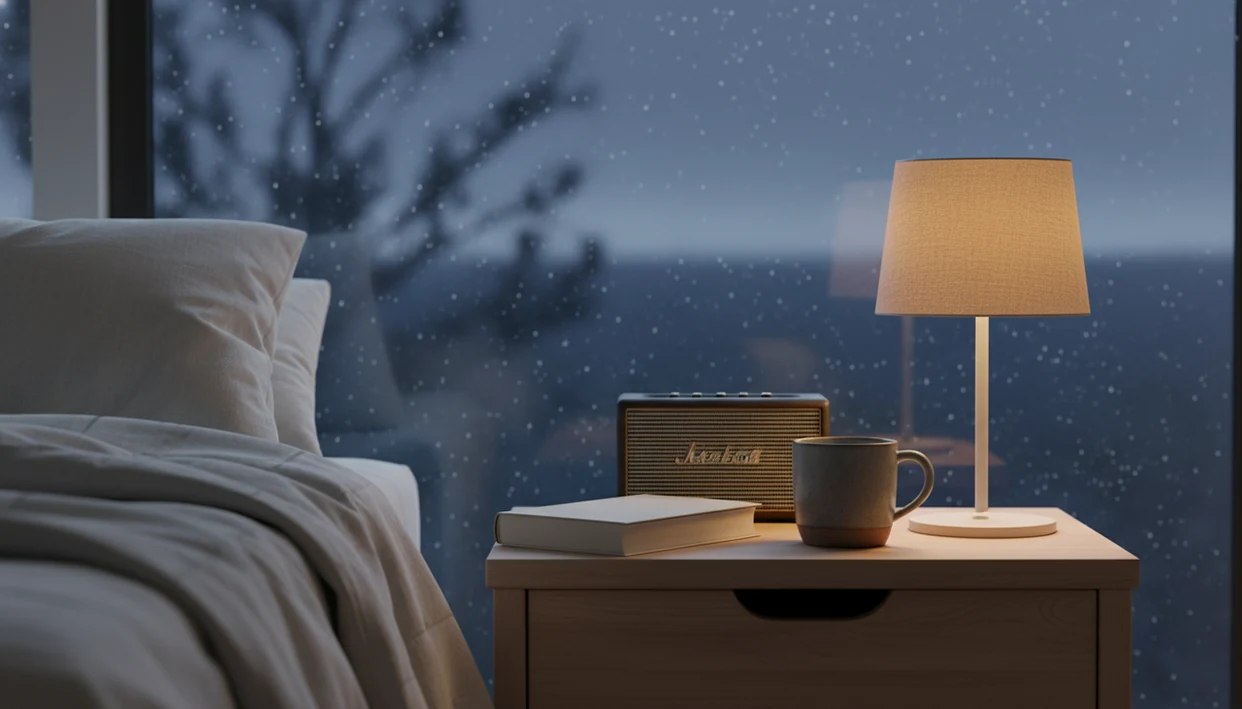
Calming stories to fall asleep work best when they are slow, predictable, and easy to leave unfinished. Choose gentle audio with low conflict, soft narration, ordinary scenes, and no cliffhangers so your attention can drift instead of lock onto the plot.
> Definition: Calming bedtime fiction is sleep-safe fiction: a low-drama story format designed to give the adult mind something soothing to follow without creating suspense, emotional spikes, or a need to know what happens next.
- Pick relaxing stories for sleep with predictable settings, low stakes, and no major twists.
- Avoid mysteries, action, sharp humor, cliffhangers, or emotionally intense character arcs at bedtime.
- Use bedtime fiction as part of a wind-down routine, not as a medical treatment for chronic insomnia.
Calming Stories To Fall Asleep: The Sleep-Safe Fiction Definition
Calming bedtime fiction is sleep-safe fiction, meaning the story is built for gentle disengagement rather than entertainment payoff. The goal is not to remember every scene. The goal is to give the mind a quiet path away from looping thoughts.
A grown-up sleep story can still have elegant language, soft atmosphere, and a real sense of place. It just avoids the hooks that keep people awake, like danger, romantic tension, sharp jokes, or a puzzle that needs solving. A quiet narrator between steady breaths often matters more than a clever ending.
Good adult bedtime audio usually sits in a family-safe lane: calming fiction, wind-down cues, and sleep sounds rather than erotic, frightening, or child-coded material.
Tools like Bedtime Adult can fit this category when you want adult bedtime audio that does not feel clinical, erotic, or childish.
At-A-Glance Qualities Of Relaxing Stories For Sleep
The best sleep story is judged by how easily attention can drift, not by how gripping the writing feels. Relaxing stories for sleep should feel safe to miss.
- Slow pacing: Scenes move at walking speed, not chase-scene speed.
- Predictable scenes: The listener can guess the general direction without effort.
- Low conflict: Low drama stories avoid arguments, danger, big reveals, and urgent goals.
- Soft sensory imagery: Rain on a roof, warm blankets, quiet rooms, and dim paths work better than spectacle.
- No cliffhangers: The story should not make you wait for one more chapter.
A gripping audiobook can be excellent and still be wrong at 10:45 p.m. If your hand reaches for the phone to restart a missed paragraph, the story is doing too much.
Why Low Drama Stories Calm Racing Thoughts
Low drama stories can calm racing thoughts by giving the mind a mild narrative track to follow. That focus can replace planning, replaying conversations, or worrying about tomorrow without demanding full attention.
The mechanism is simple. Familiar settings and repeated rhythms lower cognitive load, which means the brain has less new information to sort. A quiet cottage scene filling the room may be enough. No plot math required. Stimulating plots can raise alertness even when they feel enjoyable, especially if suspense or emotional payoff keeps building.
Sleep pressure is common. A National Sleep Foundation poll reported that 44% of adults had insomnia at least one night in the prior month, according to a 2005 PubMed-indexed report source. That does not prove stories treat insomnia. It does explain why many adults look for a softer wind-down cue before bed.
How Calming Stories To Fall Asleep Work
Calming stories to fall asleep work through low novelty, low stakes, soft narration, predictable transitions, and sensory repetition. In plain terms, the story gives your attention somewhere quiet to rest without asking it to solve anything.
Standard novels often use tension-and-resolution design. They introduce questions, sharpen conflict, and reward you for staying alert. A sleep story uses fade-out design instead. It lets details blur. If you miss how the character moved from the lane to the garden gate, nothing important breaks.
That matters in bed. The phone is face down on the nightstand, the sleep timer is already set, and the story can keep moving without you. For more on the broader category, our guide to sleep stories for adults explains how adult sleep audio differs from daytime listening.
No story should promise sleep. It can only make the room easier to leave.
Before You Start: Set Up Sleep-Safe Listening
Before you press play, make the listening setup boring, safe, and already decided. The less you adjust in bed, the less the routine turns into another round of phone handling.
- Choose your audio route before getting under the covers: soft speaker, comfortable headphones, or pillow audio. Set the volume low enough that the narrator feels near the edge of attention, not like a person speaking across the room.
- Set the sleep timer before the first sentence, and turn off autoplay so a new track does not begin after you have started to soften.
- Pick a familiar track or a low-stakes story in advance. Browsing while tired often wakes up the same part of the mind that compares, judges, and keeps choosing.
- Dim the room and screen before setup becomes stimulation. If you need the phone, use the least light and fewest taps possible.
- Decide your stopping point ahead of time. If the story becomes too interesting, pause it, switch to something plainer, or let silence take over.
How To Use Calming Stories To Fall Asleep
Use calming bedtime fiction as a repeatable wind-down cue, not as a test you have to pass. Clinicians typically recommend consistent sleep hygiene basics, such as regular routines and reducing stimulating light, The American Academy of Sleep Medicine also recommends turning off electronic devices at least 30 minutes before bed when possible source. before relying on any single bedtime tool.
- Set a timer for 10 to 30 minutes so the audio does not run all night.
- Dim the screen before you press play, since device light can reduce the benefit.
- Choose a low-drama story with ordinary scenes, soft narration, and no cliffhanger.
- Lower the volume until the narrator sits behind your thoughts, not in front of them.
- Remove distractions by avoiding late-night scrolling, message checks, and autoplay queues.
- Let the story remain unfinished if you drift off before the ending.
A 10-minute sleep story for adults often works well when you want a short cue rather than a full evening routine.
Best Story Settings For Sleep-Safe Fiction
The most sleep-friendly settings are ordinary, enclosed, and easy to imagine without effort. Quests, mysteries, and dramatic conflicts usually ask too much from a tired brain.
- Quiet garden: A character walks under trees, notices damp leaves, and listens to soft rain.
- Seaside inn: Someone folds blankets, closes shutters, and hears waves beyond the window.
- Night train: The carriage rocks gently while distant train ambience fills the pauses.
- Small village: A shopkeeper stacks linens, sweeps a step, and watches lanterns come on.
- Cozy library: A reader returns books, straightens a chair, and lets the room settle.
Ordinary actions are better than big events because they do not create urgency. Making tea, watching rain, or folding blankets gives the listener a scene to enter without a problem to solve. Grown-up does not have to mean intense; grown-up bedtime stories can stay calm, mature, and sleep-safe.
Relaxing Stories For Sleep Versus Regular Audiobooks
A good audiobook may be a poor sleep story if it creates curiosity. Sleep-safe fiction is designed to be leaveable, while many regular audiobooks are designed to be finished.
If you compare Bedtime Adult with broader relaxation apps such as Calm or Headspace, judge the individual track by its stakes, pacing, and cliffhanger risk rather than the app name alone.
| Feature | Relaxing stories for sleep | Regular audiobooks |
|---|---|---|
| Pacing | Slow, even, and repetitive | Varied, often rising toward key scenes |
| Stakes | Low or domestic | Often emotional, dangerous, comic, or urgent |
| Narration | Soft, steady, and unobtrusive | Expressive, dramatic, or character-driven |
| Emotional intensity | Mild and contained | May include grief, suspense, conflict, or strong payoff |
| Ending style | Safe to miss | Built for resolution and memory |
Humor, suspense, and strong emotional payoff can be too stimulating at bedtime. Even a favorite narrator can keep you awake if the plot makes you care too much about the next chapter. For broader adult options, compare this with bedtime stories for adults to fall asleep.
Common Mistakes With Calming Bedtime Stories
The most common mistake is choosing a story that is relaxing in mood but too active in structure. Funny essays, suspense novels, educational lectures, emotionally heavy memoirs, and plot-dense fantasy can all keep the mind working.
Another mistake is waiting for the perfect ending. That little bargain, “I’ll stop after this scene,” often becomes three more scenes. Unfinished listening is a feature, not a failure. The story did its job if you lost the thread.
Routine details matter too. A story that works on Tuesday can fail on Friday if the room is bright, the volume is too high, or autoplay keeps serving new episodes after you have already softened. Volume set too high can make narration feel intrusive. Autoplay can restart alertness just as you soften. Blue light and late-night scrolling undo the wind-down cue before the story even begins. If you share a room, partner-friendly listening may mean one notch lower after someone asks, “Can you turn it down one notch?”
Sleep is practical like that.
Evidence Behind The Wind-Down Routine
The evidence supports calming stories as part of a steady wind-down habit, not as a guaranteed way to fall asleep. The strongest practical case is for routine, lower stimulation, and fewer alerting cues before bed.
- Build a repeatable sequence so the story becomes one familiar cue among sleep hygiene basics: dim room, quieter body, softer attention, then audio.
- Dim devices before pressing play because bright screen handling can work against the same calm you are trying to create.
- Choose low-stimulation fiction instead of suspense, comedy spikes, or cliffhangers. A plot that asks “what happens next?” keeps attention reaching forward.
- Treat relaxation as the goal rather than measuring whether sleep arrives by a certain minute. The story can make bedtime less busy without controlling biology.
- Separate wind-down support from treatment if insomnia is chronic, severe, or paired with panic, breathing symptoms, or daytime impairment. Clinical insomnia care belongs with a qualified professional, while bedtime stories are a general comfort tool.
In other words, the routine is evidence-aligned, but the promise should stay modest.
Limitations
Calming stories can support general relaxation, but they are not a proven cure for chronic insomnia or sleep disorders. They work best as one small part of a consistent bedtime routine.
- Calming stories are not a substitute for medical care if insomnia, panic, sleep apnea symptoms, or severe daytime sleepiness persist.
- Personal preference matters; one listener may relax with rain and soft narration, while another finds any voice too engaging.
- High anxiety, pain, medication effects, irregular schedules, caffeine, alcohol, or screen habits may overpower story benefits.
- Plot choice can backfire; suspense, sharp humor, emotional twists, or dense information can raise alertness.
- Shared rooms require compromise on volume, speaker placement, and story style.
- Youth sleep and stress data show the wider pressure around rest, not proof that bedtime stories solve it. The 2023 CDC Youth Risk Behavior Survey found that 77.0% of high school students got less than 8 hours of sleep on an average school night, and almost 1 in 3 reported poor mental health most of the time or always source.
FAQ
What are calming sleep stories?
Calming sleep stories are low-drama bedtime fiction designed to help attention drift. They use predictable scenes, soft narration, and low emotional intensity.
Do sleep stories really work?
Sleep stories may help some people relax as part of a bedtime routine. They are not a guaranteed treatment for insomnia or a replacement for medical advice.
What story plots help sleep?
Predictable, ordinary, low-stakes plots usually work well. Gentle sensory details, familiar places, and calm transitions are more sleep-friendly than twists.
Are audiobooks good for sleep?
Audiobooks can work if they are slow, familiar, and easy to stop. They may be too gripping if they use suspense, strong humor, or emotional cliffhangers.
Should sleep stories be boring?
Sleep stories should be soothingly uneventful, not poorly written. The writing can be graceful while still avoiding tension and surprise.
Can adults use bedtime stories?
Yes, adults can use bedtime stories that are mature, calming, and family-safe. Apps such as Bedtime Adult focus on Sleep Stories for Grown Ups without childish or explicit framing.
How long should sleep stories be?
Many listeners use 10 to 30 minutes with a sleep timer. It is normal and intended to leave the story unfinished.
What should I avoid at bedtime?
Avoid suspense, action, sharp comedy, heavy emotional arcs, and dense learning content. Also avoid bright screens, late scrolling, loud volume, and autoplay.