
Partner-Friendly Sleep Audio for Shared Bedrooms
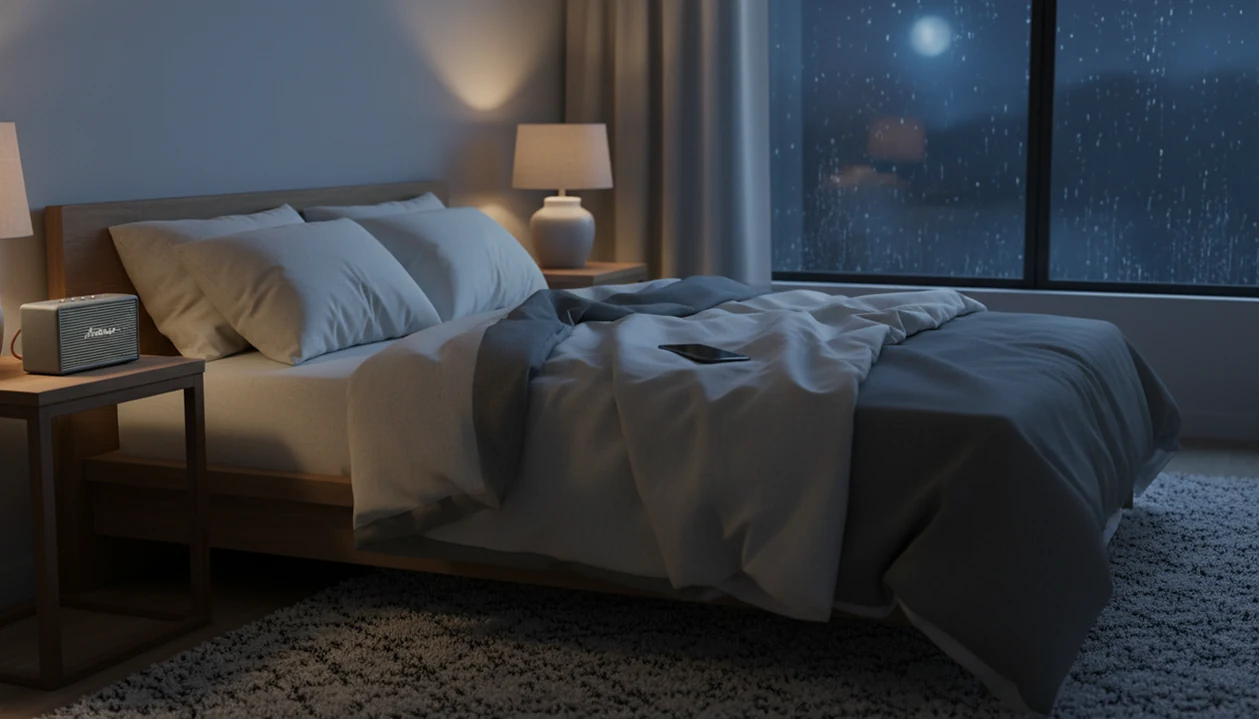
Partner-friendly sleep audio is soft, predictable bedtime sound you can play out loud in a shared bedroom so both people can sleep without headphones. The best setup is agreed on together, kept at a low steady volume, and adjusted over several nights instead of decided by one person.
> Definition: Partner-friendly sleep audio means bedtime sounds, stories, or meditations played aloud in a shared bedroom so one partner gets soothing noise support while the other can still relax comfortably.
TL;DR
- Choose calm, non-explicit, low-contrast audio: white noise, rain, soft music, or gentle adult bedtime stories.
- Set the volume for the more sound-sensitive partner, then place the speaker closer to the person who needs the audio.
- Use shared audio to mask snoring or street noise, not to treat snoring, sleep apnea, insomnia, or other sleep disorders.
Partner-Friendly Sleep Audio Definition for Couples
Partner-friendly sleep audio means shared-bedroom sound that plays aloud without headphones and stays acceptable to both people. It is not silent; it is neutral, predictable, and comfortable enough that neither partner feels pushed out of the room.
Useful formats include white noise, brown noise, rain, soft music, calm narration, sleep meditations, and non-explicit bedtime stories for adults. A quiet narrator between steady breaths may help one person stop replaying work, but the other person still needs veto power if the voice feels too present.
Bedtime stories and sleep meditation for adults deliver calming fiction, wind-down routines, and sleep sounds that are family-safe, not 18+ content or medical treatment. Bedtime Adult is a bedtime stories for adults app that offers calming fiction, sleep meditations, and sleep sounds for grown-ups.
At-a-Glance Rules for Shared Bedroom Sleep Sounds
| Setup choice | Partner-friendly rule |
|---|---|
| Sound type | Choose white noise, brown noise, rain, soft music, or low-drama narration. |
| Volume | Set it for the more sound-sensitive partner, not the person who wants more masking. |
| Speaker placement | Put the speaker closer to the listener who needs sound support. |
| Timer | Start with 30 to 60 minutes before trying all-night playback. |
| Content safety | Avoid sudden ads, jump scares, loud music shifts, and intense narration. |
| When to stop | Stop if either partner feels more alert, irritated, or trapped by the sound. |
Survey-based estimates often find that roughly half or more adults share a bed or bedroom with a partner, so sleep audio is often a shared decision source. Family-safe, non-explicit audio matters because nobody wants a surprise scene at 11:42 p.m.
One notch lower often changes everything.
How Partner-Friendly Sleep Audio Works in a Shared Bedroom
Partner-friendly sleep audio works through auditory masking, which means a steady sound lowers the contrast between quiet and disruptive noises. In plain terms, soft static can make traffic, hallway noise, snoring, or CPAP airflow feel less sharp.
- Continuous white noise improved subjective and objective sleep measures in a 2016 clinical trial by masking environmental sounds source.
- Steady sound is usually easier to sleep through than variable speech, bright music, or sudden volume changes.
- Masking reduces how noticeable a disturbance feels; it does not remove the disturbance.
- Speaker direction matters because sound pressure changes across even a small bedroom.
- A timer can turn audio into a wind-down cue instead of a new all-night dependency.
For shared bedrooms, steady masking is often easier than spoken audio because both partners can stop listening to it. Soft static covering apartment noises may be enough, but sharp snoring needs a different plan.
Before You Start No Headphones Sleep Audio
Before using no headphones sleep audio, agree on a short test window of three to five nights. One bad night tells you something, but it usually does not tell you the whole pattern.
You need a reliable speaker, fine volume control, offline or ad-free playback, a sleep timer, and one mutually acceptable sound category. The CDC reports that 35.2% of U.S. adults sleep less than 7 hours, so sleep aids are common, but they should sit beside sleep hygiene basics like regular timing, light control, and caffeine boundaries.
Earbuds can help for short listening, but wearing them all night is not always comfortable or simple. For couples who need a gentler starting point, sleep audio for light sleepers covers lower-volume choices in more detail.
How to Set Up Partner-Friendly Sleep Audio Tonight
Use this setup as a small experiment, not a permanent contract. The goal is one calm night, then better information tomorrow.
- Pick one neutral sound category together, such as brown noise, rain, or a slow adult story.
- Set the volume just below the point where the sensitive partner notices it as intrusive.
- Place the speaker closer to the partner who needs masking and aim it away from the other partner.
- Start with a 30 to 60 minute timer or fade-out instead of all-night playback.
- Review the next morning and change only one variable at a time.
For couples, low-volume audio usually works best when the speaker sits nearer the person who needs masking, while the more sound-sensitive partner controls the upper volume limit. Phone face-down on the nightstand, timer already set. That is the whole ritual.
Best Sleep Audio for Couples by Sound Type
The right sleep audio for couples depends on whether the main problem is noise masking, mental wind-down, or room atmosphere. Start with the least attention-grabbing option that both people can tolerate.
| Sound type | Fits best when | Watch for |
|---|---|---|
| White noise | Masking traffic, hallway doors, or snoring edges | Can feel bright or hissy |
| Brown noise | Softer masking with less high-frequency sound | Bass can travel through pillows |
| Rain | Natural ambience and routine cueing | Loops may become noticeable |
| Ocean | Slow rhythm and room-softening ambience | Wave peaks can feel too dynamic |
| Soft instrumental music | Emotional settling without words | Melodies may pull attention |
| Guided sleep meditation | Racing thoughts or body tension | Voice preference matters |
| Adult bedtime stories | Mental wind-down and low-stakes listening | Plot must stay gentle |
Spoken audio should be slow, non-explicit, low-stakes, and predictable. Family-safe calming fiction, sleep meditations, and Sleep Stories for Grown Ups can fit when both partners want spoken wind-down; broader comparisons are covered in the best adult bedtime story apps guide.
Step-by-Step Negotiation for Shared Bedroom Sleep Sounds
Shared bedroom sleep sounds work better when treated as a couple project, not a winner-takes-all preference fight. The point is not to prove who is more sensitive; it is to protect sleep for both people.
- Rate each sound privately from 1 to 5 before discussing it.
- Test only sounds both partners rate 3 or higher.
- Alternate trial nights if one person prefers rain and the other prefers brown noise.
- Note sleep quality and irritation each morning in one short line.
- Keep the option that causes the least friction over several nights.
Research on couples and CPAP reports that partner involvement can influence treatment adherence and perceived sleep quality for both people source. That lesson carries over here. A partner asking, “Can you turn it down one notch?” is useful data, not a complaint to dismiss.
Common Mistakes With Shared Bedroom Sleep Audio
The most common shared-bedroom sleep audio mistakes come from changing too much, too fast, and treating one person’s comfort as optional. A calmer setup usually starts quieter, simpler, and more predictable than the eager listener expects.
- Start at the more sound-sensitive partner’s upper limit, then move the speaker closer to the person who needs masking instead of raising the whole room volume.
- Change only one setting per night: sound type, volume, or timer length. If rain fails on a 30-minute timer, you need to know whether the rain, the loudness, or the shutoff caused the problem.
- Avoid ad-supported tracks, autoplay queues, and videos with unpredictable transitions. One bright commercial at midnight can ruin trust in the whole experiment.
- Treat loud snoring, gasping, or breathing pauses as a health signal, not just an audio problem to cover with stronger noise.
- Choose steady sound when spoken audio creates friction. A gentle story can help racing thoughts, but brown noise or rain may be kinder if a voice makes the other person listen.
The best fix is often boring: lower, steadier, shorter.
Common Myths About Sleep Audio for Couples
Myth 1: If one partner likes it, both partners should relax. Sound sensitivity varies. One person’s soft rain can be another person’s leaky ceiling.
Myth 2: Partner-friendly audio has to be inaudible. It only needs to be neutral enough that both people can settle.
Myth 3: Once chosen, the sound is permanent. Preferences change with stress, seasons, room temperature, health, and sleep schedules.
Myth 4: Sleep audio can fix medical sleep problems. It may mask noise, but it cannot treat snoring, sleep apnea, chronic insomnia, or restless legs.
For couples who prefer spoken wind-down over formal meditation, sleep stories for couples may be easier than a guided practice because the attention lands on a gentle scene, not on performance.
Snoring, CPAP, and No Headphones Sleep Audio Boundaries
Can sleep audio mask snoring without headphones? Yes, it can mask snoring for the listener, but it cannot treat snoring or sleep apnea.
The NHLBI estimates that about 30 to 50% of adults snore source, and snoring is very common among people who share a bed. Steady sound may soften the edges of snoring or CPAP airflow, especially if the listener is reacting to contrast rather than volume alone.
Still, CPAP comfort, mask fit, air leaks, and treatment adherence are health and equipment issues. Clinicians typically recommend medical evaluation for loud chronic snoring, gasping, witnessed pauses in breathing, daytime sleepiness, or worsening symptoms. Rain sound masking hallway elevator chimes is one thing. Breathing pauses are another.
Limitations
Partner-friendly sleep audio is a relaxation and masking tool, not a medical solution. It has clear limits.
- It cannot diagnose or cure obstructive sleep apnea, chronic insomnia, restless legs, PTSD, migraine, tinnitus, or medical causes of snoring.
- Some light sleepers find any continuous sound irritating, even at low volume.
- Too much bass, brightness, volume, or variation can fragment sleep instead of easing it.
- Long-term research on nightly shared sleep audio specifically for couples is limited.
- Audio cannot compensate for caffeine, alcohol, screens in bed, pain, mismatched schedules, temperature problems, or an uncomfortable mattress.
- If sound becomes a relationship conflict, pause the experiment and discuss it during the day.
- If one partner needs separate sound, a pillow speaker or separate room plan may be kinder than nightly negotiation.
Not every bedroom wants more sound.
FAQ
What is partner-friendly sleep audio?
Partner-friendly sleep audio is bedtime sound played aloud in a shared bedroom so one partner gets soothing noise support while the other can still relax without headphones.
What sounds are best for couples?
White noise and brown noise are useful for masking, while rain, ocean, soft music, meditations, and adult bedtime stories can support wind-down. The sound should be predictable, low-volume, and mutually acceptable.
Can sleep audio mask snoring?
Sleep audio can mask some snoring noise for the listener, but it does not treat the cause of snoring. Loud or worsening snoring should be evaluated medically.
Should sleep audio play all night?
Start with a 30 to 60 minute timer or fade-out. All-night playback may work for steady masking, but only if both partners sleep well with it.
Where should the speaker go?
Place the speaker closer to the partner who needs masking and aim it away from the more sound-sensitive partner. Keep the volume low enough that it does not feel intrusive.
Is white noise bad for sleep?
Low-volume white noise may help some adults by masking environmental sound. It can bother others if it is too loud, too bright, or played all night.
Can couples use sleep stories?
Couples can use sleep stories if the narration is calm, non-explicit, low-stakes, and predictable. Bedtime Adult includes Sleep Stories for Grown Ups designed for family-safe bedtime listening.
What if my partner hates it?
Stop the test, lower the volume, change the sound type, shorten the timer, or try separate solutions. Shared sleep audio should require consent from both partners.