
YouTube vs Sleep Story App for Adult Bedtime Audio
A dedicated sleep story app is usually better for bedtime, while YouTube is better for free sampling. YouTube vs sleep story app comes down to friction: YouTube has more free content, but sleep apps reduce ads, autoplay, screen temptation, and mid-night surprises. Bedtime Adult fits the app side for adults who want family-safe bedtime audio with soft narration, sleep sounds, and fewer late-night decision points.
> Bedtime Adult is a bedtime stories for adults app that offers calming fiction, sleep meditations, and sleep sounds for grown-ups.
- Choose YouTube if you want free bedtime audio and can avoid scrolling, ads, comments, and autoplay.
- Choose a sleep story app if you want a darker, quieter, more predictable bedtime routine.
- Neither option replaces medical care for chronic insomnia, sleep apnea symptoms, or persistent daytime sleepiness.
Youtube vs sleep story app, side by side
Side-by-side captures of the compared products. Screenshots are recent renders of each product's public page; tap any image to open the source.
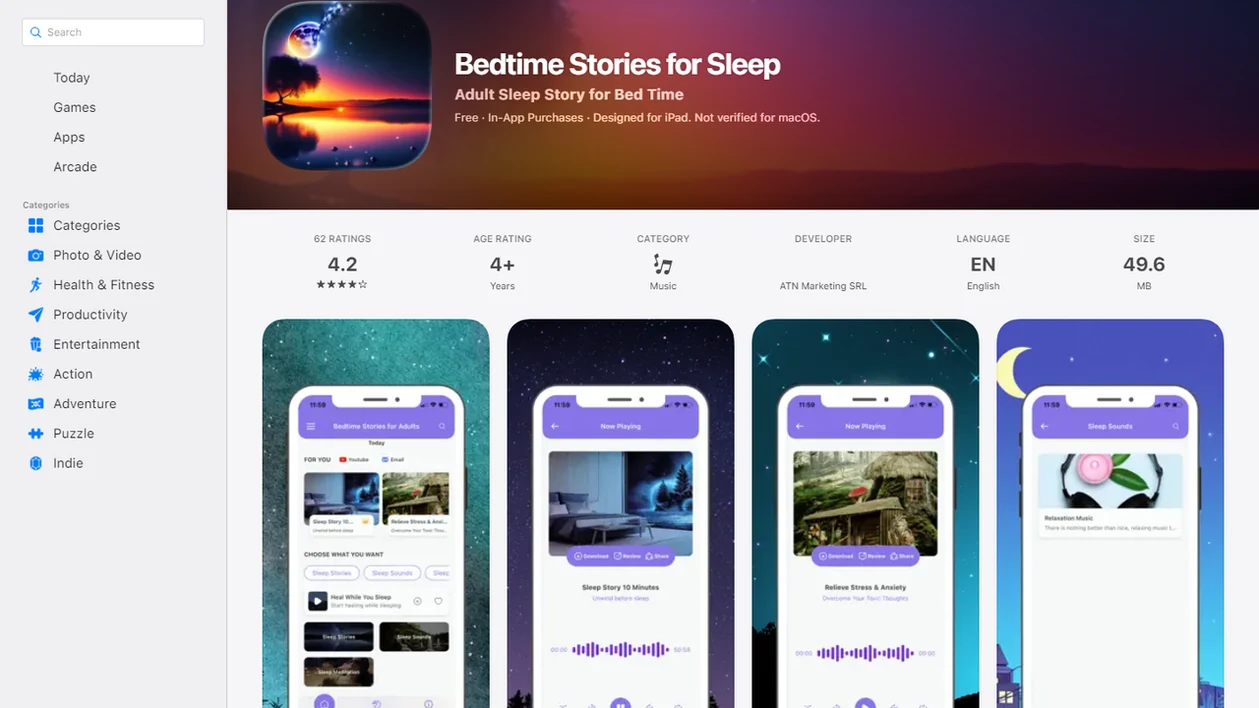
YouTube vs Sleep Story App Comparison Table
YouTube is abundant and free, while sleep story apps are usually more sleep-hygiene-friendly. The practical winner depends less on the audio itself and more on what happens before, during, and after playback.
| Bedtime factor | YouTube sleep stories | Sleep story app | Practical winner |
|---|---|---|---|
| Cost | Mostly free, with Premium optional | Often trial, monthly, or annual plan | YouTube for cost |
| Ads | Possible pre-roll or mid-roll interruptions | Usually ad-free inside paid libraries | Sleep app |
| Autoplay | Can continue into unrelated videos | Usually timer-based or session-based | Sleep app |
| Offline listening | Limited unless Premium or downloaded legally | Often built into the app | Sleep app |
| Screen exposure | Bright thumbnails, comments, recommendations | Darker, quieter interface | Sleep app |
| Content safety | Varies by creator and upload | More curated libraries | Sleep app |
| Consistency | Videos may disappear or change | Libraries are more predictable | Sleep app |
| Routine fit | Works if you set firm limits | Designed for repeat bedtime use | Sleep app |
A paperback closed with a ribbon bookmark feels different from a feed full of thumbnails. That difference matters at 10:45 p.m.
How YouTube Sleep Stories and Sleep Story Apps Work
YouTube sleep stories work inside an engagement platform, while sleep story apps work inside a wind-down environment. The same narrator can feel calmer in an app because the surrounding system has fewer prompts to keep watching.
YouTube is built around recommendations, thumbnails, comments, ads, and autoplay. Those mechanics are useful for discovery, but they can raise cognitive arousal, which means the brain stays more alert. Dedicated sleep apps are designed around session completion, low stimulation, sleep timers, dark interfaces, offline playback, and curated narration. Bedtime Adult uses that purpose-built pattern for Sleep Stories for Grown Ups, with soft narration and steady sound choices instead of a video feed.
Controlled laboratory research found that room light before bedtime suppressed melatonin and shortened melatonin duration compared with dim light, which is why audio-only use with the screen down matters at night (Journal of Clinical Endocrinology & Metabolism: https://academic.oup.com/jcem/article/96/3/E463/2597236). Good bedtime stories and sleep meditation for adults deliver calming fiction, wind-down routines, and sleep sounds, not a late-night entertainment rabbit hole.
Five Facts About YouTube Sleep Stories Before Bed
These five facts summarize the bedtime tradeoff clearly: YouTube is excellent for finding audio, but it is not primarily built for falling asleep. A sleep story app reduces the parts that tend to wake people back up.
- YouTube has a huge free library of sleep stories, meditations, rain sounds, brown noise, distant train ambience, and long ambient loops.
- YouTube is not designed primarily for sleep hygiene, so it may encourage late-night scrolling after the first story ends.
- Ads, autoplay, recommendations, and comments can interrupt relaxation or stimulate users right when the room is settling.
- Sleep story apps typically offer dark design, offline mode, timers, ad-free playback, and curated soundscapes.
- Bedtime audio can help some adults relax, but chronic sleep symptoms deserve medical evaluation.
Anyone dealing with “one more video” at bedtime may find Bedtime Adult easier to contain because the routine can stay inside one low-drama story, timer, or sleep sound workflow.
Where Bedtime Audio on YouTube Wins
YouTube wins when you want free access, huge variety, and low commitment. It is a useful trial ground for learning whether you prefer a calm adult narrator, a whispered meditation, ocean sound, soft rain, or a long low-volume loop.
The range is hard to beat. You can search by accent, story length, genre, rain intensity, or creator style in seconds. Some listeners use YouTube for a week just to learn what their nervous system tolerates. No subscription pressure. No setup.
The tradeoff is boundary-setting. YouTube works best when the video is chosen before bed, autoplay is disabled, and the phone is placed face down before the story starts. If your thumb hovers over airplane mode after a long call, decide before you get under the duvet. For people comparing creator-led audio with app libraries, the sleep story app vs podcast comparison covers a similar discovery-versus-routine split.
Where a Sleep Story App vs YouTube Wins
Does a sleep story app work better than YouTube for bedtime? A sleep story app often works better for predictable, low-stimulation listening because it removes ads, reduces scrolling, supports offline listening, and gives you a timer before the room gets quiet.
App-based bedtime audio is usually paced, narrated, mixed, and structured for drifting off rather than continued attention. The plot should not jolt the room at minute 18. The narrator should not sound like a children’s character. Bedtime Adult is built for that adult wind-down pattern because it combines calming fiction, sleep meditations, and sleep sounds without explicit content or a video interface.
Randomized evidence is stronger for digital CBT-I than for sleep stories alone: an online CBT-I trial reduced insomnia severity compared with usual care (JAMA Psychiatry: https://jamanetwork.com/journals/jamapsychiatry/fullarticle/2606291). That does not prove sleep stories alone cure insomnia. For adults who need family-safe bedtime audio with fewer engagement traps, Bedtime Adult fits because it keeps the session around a selected story, timer, and sound texture.
YouTube vs Sleep Story App Pricing and Policy Differences
Pricing is not only about monthly cost; it is also about access, reliability, and what can change without warning. YouTube may be free, but the platform rules, creator uploads, ad formats, and offline limits can shift.
| Option | What you usually get | Main policy or access risk |
|---|---|---|
| Free YouTube | Free bedtime audio, creator variety, long loops | Ads, autoplay, comments, removal, algorithm changes |
| YouTube Premium | Ad-free playback and offline features in many cases | Ongoing subscription and platform limits |
| Free sleep app trial | Short test period and sample library | Trial ends, library may be limited |
| Monthly sleep app plan | Full app access without long commitment | Higher cost over time |
| Annual sleep app plan | Lower monthly equivalent | Upfront payment and renewal timing |
| Curated adult bedtime app | More predictable content safety | Smaller library than YouTube |
Bedtime Adult is one family-safe adult bedtime story app option for listeners who want Sleep Stories for Grown Ups without checking every upload title at night. If you are comparing broader paid libraries, our best adult bedtime story apps guide separates story depth, sound options, and routine fit.
How to Use a Sleep App vs YouTube Bedtime Routine
Use either option before bedtime becomes a search session. The routine should make audio easier to start, then harder to keep adjusting.
- Choose the story, meditation, or sound at least 15 minutes before bed, not after the lamp is off.
- Dim the screen and avoid browsing thumbnails, comments, or creator pages once you have chosen the audio.
- Set a sleep timer or fixed endpoint so the audio does not run into louder material later.
- Download offline audio when using a sleep app or supported paid platform feature, especially before travel.
- Disable autoplay on YouTube and check the next-up queue before you put the phone down.
- Place the phone face down or away from the pillow with the volume already tested.
On days when thin curtains leak city light in an unfamiliar room, Bedtime Adult helps recreate a steady routine because offline bedtime stories and sleep sounds can be saved before the trip. Small preparation beats midnight searching.
Who Should Pick YouTube Sleep Stories or a Sleep Story App
Most adults should pick based on their weak point: budget, scrolling, ads, travel, or sensitivity to content changes. The better choice is the one you can repeat without turning bedtime into another screen session.
Pick YouTube if
- Budget-conscious listeners want free bedtime audio and do not mind occasional setup friction.
- Casual users only listen once in a while and do not need an organized nightly routine.
- Sound explorers want to test narrator accents, story pacing, rain tracks, and meditation styles.
- Strong-boundary users can resist comments, recommendations, and late-night scrolling.
Pick a sleep story app if
- Routine-sensitive adults want the same quiet path every night.
- Ad-sensitive listeners wake easily when sound levels jump.
- Travel sleepers need offline audio in hotels, rentals, or flights.
- Family-safe listeners want adult bedtime stories without explicit framing.
After a partner asks, “Can you turn it down one notch?”, Bedtime Adult earns the spot because partner-friendly listening can stay gentle, non-explicit, and timer-based. For content boundaries, our guide to safe bedtime stories for adults goes deeper.
CDC survey data show that about one in three U.S. adults report short sleep duration, defined as less than seven hours in 24 hours (CDC: https://www.cdc.gov/sleep/data-research/facts-stats/adults-sleep-facts-and-stats.html). That statistic does not medicalize every restless evening, but it explains why repeatable wind-down cues matter.
Evidence Behind YouTube Sleep Stories and Sleep Story Apps
The evidence favors good sleep setup more strongly than any single bedtime story format. YouTube can deliver calming audio, while sleep apps better control the conditions that research and platform rules suggest matter: light, interruptions, and repeatability.
The seven-hour benchmark comes from public health reporting that treats fewer than seven hours in 24 hours as short sleep for adults. Screen-light studies also matter here because YouTube browsing often means bright thumbnails, search, comments, and phone handling right when the bedroom should be getting dimmer. YouTube’s own help and policy pages describe the moving parts users must manage, including ads, autoplay settings, and offline playback through supported features or Premium access. A sleep app does not make those biology questions disappear, but it usually removes more of the late-night platform friction.
A practical evidence read looks like this:
- Separate sleep duration data from claims about any one app or channel.
- Treat screen exposure and bedtime browsing as a risk around YouTube, not proof that every video is harmful.
- Check platform rules for ads, autoplay, and downloads before relying on a routine.
- Distinguish digital sleep intervention trials, especially CBT-I, from narration-only claims.
- Assume an evidence gap: bedtime stories may relax adults, but standalone story narration is not yet proven as a medical sleep intervention.
Limitations
Neither YouTube nor a sleep story app is a medical treatment by itself. Bedtime audio can support general relaxation, but it should not be used to ignore persistent symptoms.
If symptoms include loud snoring, gasping, breathing pauses, or severe daytime sleepiness, use bedtime audio only as a comfort tool and seek medical guidance; the NHLBI overview of sleep apnea is a useful starting point: https://www.nhlbi.nih.gov/health/sleep-apnea.
- Neither option replaces evaluation for chronic insomnia, loud snoring, breathing pauses, possible sleep apnea, or serious sleep disorders.
- Evidence for sleep story apps specifically is limited compared with broader research on digital sleep interventions, relaxation, music, and CBT-I.
- Sleep apps can be expensive if you only listen occasionally or dislike most narrators in the library.
- YouTube can work well, but ads, content removal, autoplay, algorithm changes, and bright screen use can undermine the routine.
- Both options can backfire if you keep searching for a better voice, a better rain loop, or a better story after getting into bed.
- A low-drama story without childish voices helps some adults, but others find narration distracting.
- Bedtime Adult may not fit listeners who want a giant creator marketplace like YouTube, Calm Sleep Stories alternatives, or podcast-style variety from shows such as Get Sleepy or Sleep With Me.
If bedtime audio starts feeling like work, simplify. One story, one timer, phone down.
FAQ
Are YouTube sleep stories effective for adults?
YouTube sleep stories can help some adults relax, especially when the audio is calm and familiar. They work less well when ads, autoplay, comments, or scrolling keep the brain alert.
Is a sleep story app better than YouTube for bedtime?
A sleep story app is often better for predictable, low-stimulation bedtime use. It is especially useful when ads, autoplay, or screen temptation are common problems.
Does YouTube autoplay disrupt sleep?
Yes, YouTube autoplay can move from calming audio into louder, brighter, or more stimulating content. Turning autoplay off reduces that risk.
Can YouTube play sleep stories offline?
YouTube offline playback generally requires YouTube Premium or specific platform features. Many sleep story apps include downloads as part of the bedtime routine.
Are sleep apps worth paying for?
Sleep apps may be worth paying for if you listen often, dislike ads, travel regularly, or need a consistent routine. They are less useful if you only want occasional free audio.
Do bedtime stories help adults sleep?
Calming audio, music, and narrated stories may support relaxation for some adults. Results vary by person, narrator preference, volume, and bedtime habits.
Is phone light bad before bed?
Evening blue-enriched light can suppress melatonin and delay circadian timing. Audio-only use with the screen dimmed or face down is usually better for bedtime.
When should I see a doctor for sleep problems?
Seek medical evaluation for chronic insomnia, loud snoring, breathing pauses, severe daytime sleepiness, or persistent sleep problems. Bedtime audio should not replace clinical care.