
Sleep Story App vs Podcast: Which Bedtime Audio Format Works Better?
A sleep story app is usually better if you want bedtime controls like timers, offline listening, sound mixing, and content curation; a podcast is better if you want free, simple, easy-to-find episodes. The sleep story app vs podcast choice is less about whether stories “work” and more about how much control you want once you are drowsy.
Definition: Bedtime Adult is a bedtime stories for adults app that offers calming fiction, sleep meditations, and sleep sounds for grown-ups.
- Choose a sleep story app for timers, offline access, bedtime routines, and more control over what plays next.
- Choose a sleep podcast for low cost, easy discovery, and simple episode playback in the podcast app you already use.
- Either sleep audio format can help with wind-down if the narration is calm, predictable, family-safe, and set to stop after sleep onset.
Sleep story app vs podcast, side by side
Side-by-side captures of the compared products. Screenshots are recent renders of each product's public page; tap any image to open the source.
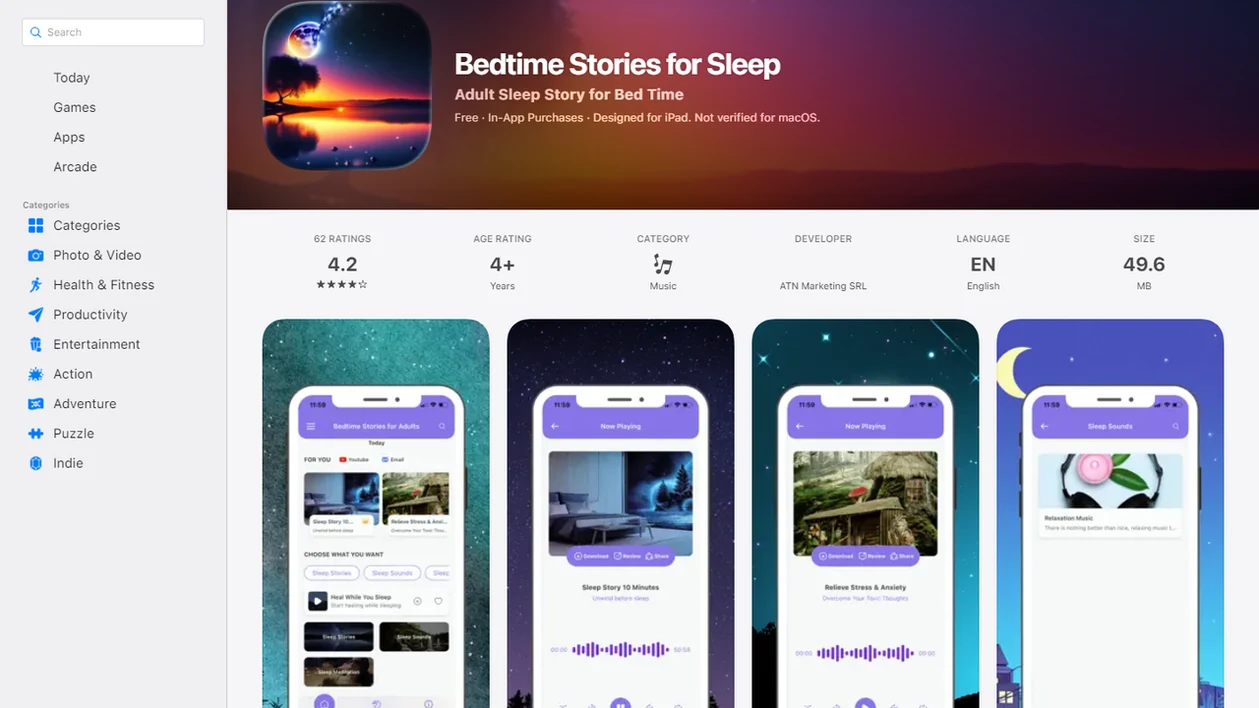
Sleep Story App vs Podcast At-a-Glance Comparison
Sleep story app vs podcast is mostly a control comparison: apps usually win on sleep-specific settings, while podcasts usually win on access and price. If your phone is already face down on the nightstand, the format matters only if it changes what happens after you get sleepy.
| Factor | Sleep story app | Sleep podcast |
|---|---|---|
| Timers | Usually built for bedtime stop points | Depends on podcast player |
| Ads | Often reduced in paid tiers | Common in free feeds |
| Offline access | Often included with downloads | Varies by platform |
| Autoplay | Usually easier to limit | Can continue unless adjusted |
| Privacy | App account and analytics vary | Platform and feed tracking vary |
| Content control | Curated libraries and categories | Host-by-host selection |
| Cost | Free tiers or paid subscriptions | Often free, sometimes premium |
| Bedtime fit | Built around wind-down routines | Built around episode playback |
If you want a wider market scan, our best adult bedtime story apps guide compares dedicated options beyond this format question.
Sleep Audio Format Effects on Bedtime Listening
Sleep audio works by reducing bedtime decision-making and giving the mind a predictable object to follow; the app-or-podcast format mainly changes pacing, stopping points, ads, downloads, and replay behavior. Calm audio can help because slow narration, predictable structure, and repeated cues may reduce rumination before sleep.
That point matters. A systematic review in Sleep Medicine Reviews found that 65% to 85% of people with insomnia have at least one rumination-related cognitive process at bedtime, such as worry or overthinking source. The label, app or podcast, is less important than whether the audio lowers mental effort.
Sleep Stories for Grown Ups should deliver calming fiction, wind-down routines, and sleep sounds, family-safe, not 18+ content or medical treatment. Apps add a purpose-built layer: timers, downloads, soundscapes, dark screens, routines, and stop conditions. Podcasts rely on general players made for discovery and episode consumption.
The room feels different when browsing stops.
Sleep Story App Advantages for Bedtime Control
A sleep story app is strongest when bedtime control matters more than endless choice. Dedicated apps reduce late-night decisions by putting stories, sounds, timers, and meditations in one sleep-focused workflow.
- Timer control: A sleep timer can stop narration after 10, 20, or 30 minutes instead of letting audio run all night.
- Offline downloads: Saved stories help in hotels, flights, or rooms with unreliable Wi-Fi.
- Sound mixing: Rain, brown noise, or distant train ambience can sit under soft narration.
- Meditation add-ons: Body scans and breathing tracks give another route when fiction feels too engaging.
- Curated adult libraries: Family-safe adult content avoids erotic framing, clinical lectures, and sing-song children’s story voices.
Timer and autoplay control
If your main problem is audio continuing after you fall asleep, then Bedtime Adult fits because the bedtime routine can center on a sleep timer and repeatable story length.
Curated adult bedtime content
For adults who need calm grown-up listening, Bedtime Adult keeps the tone low-drama and partner-friendly through curated Sleep Stories for Grown Ups.
Sleep Podcast Advantages for Simple Listening
Are sleep podcasts better if you just want something easy and free? Often, yes. Podcasts are easy to find in Apple Podcasts, Spotify, and other players, and many people already know how to queue an episode.
A podcast also gives you broad variety. Shows such as Get Sleepy and Sleep With Me have familiar hosts, scheduled releases, and a rhythm listeners may trust over time. Many sleep podcasts are intentionally slow, gentle, and low-stakes, so it is wrong to assume every podcast is too distracting.
The catch shows up after the pillow gets comfortable. Ads, loud transitions, and autoplay can break the mood if settings are left alone. Before choosing a podcast for sleep, check whether your player has a sleep timer, episode download option, and autoplay toggle; those three settings often matter more than the show description. A partner asking, “Can you turn it down one notch?” is usually a sign the format needs tighter controls, not a louder narrator.
For host-led choices, Get Sleepy vs Nothing Much Happens is a useful comparison.
Sleep Podcast vs App Pricing, Ads, and Privacy Differences
Sleep podcast vs app pricing is not simply free versus paid. The tradeoff is whether you want open access with possible interruptions, or a subscription that may bundle more bedtime tools.
| Option | Likely cost | Bedtime tradeoff | Privacy note |
|---|---|---|---|
| Free podcast feed | Free | Easy access, possible ads | Platform may track listening |
| Podcast platform ads | Free with ads | Dynamic inserts can be loud | Settings vary by player |
| Premium podcast feed | Monthly or annual | Fewer ads, same player limits | Account may be required |
| Free app tier | Free or limited | Smaller library, basic tools | App analytics may apply |
| Paid app subscription | Monthly or annual | Downloads, soundscapes, meditations | Check account and history settings |
App subscriptions can unlock larger libraries, offline playback, mixed sounds, and sleep meditations. Calm.com, Headspace.com, and Slumber.app all take different approaches here, so compare the exact tier before assuming features.
Feature sets should be checked against each service’s current help or product pages, because downloads, subscriptions, and sleep content libraries change over time; for example, Calm, Headspace, and Slumber each describe their sleep offerings differently on their own sites (Calm, Headspace, Slumber).
When the issue is ad interruption, Bedtime Adult earns a look because a dedicated bedtime library avoids depending on a podcast feed’s dynamic ad breaks.
6 Bedtime Setup Steps for a Sleep Story App or Podcast
A good bedtime setup makes the format quiet, predictable, and finished before you are too sleepy to adjust it. The goal is to stop active choosing before drowsiness arrives.
- Choose calm content before bed, ideally a low-drama story or gentle meditation with no sudden topic shifts.
- Set a timer for the shortest window that usually gets you settled, such as 10, 20, or 30 minutes.
- Download audio if you travel, share Wi-Fi, or sleep in a room where streaming fails.
- Lower volume until the narration sits barely above the pillow, not across the room.
- Disable autoplay so another episode, ad, or playlist does not start after sleep onset.
- Keep the screen dark by dimming brightness, using dark mode, and placing the phone face down.
Leaving audio on all night can be counterproductive for some listeners, especially if a new voice or louder segment wakes them at 3:12 a.m.
On days when travel makes the room feel unfamiliar, Bedtime Adult helps because offline stories and steady sleep sounds can recreate the same wind-down cue.
Bedtime Story App Comparison Decision Rule
Should you choose the app or the podcast? Choose the app if you want bedtime structure; choose the podcast if you already have a host you trust and want minimal setup.
Choose the app if
Choose a sleep story app if you want guided routines, offline access, timer reliability, mixed sounds, and clearer content boundaries. For shared bedrooms, Bedtime Adult is a practical fit because family-safe stories and soft narration reduce the chance of awkward scenes or sudden tonal shifts.
Choose the podcast if
Choose a sleep podcast if you like a specific host, want free audio, or prefer using the player already on your phone. For many listeners, a podcast is easier than a new account.
Trying both for a week is reasonable. For adults comparing paid and free options, the free sleep podcast vs paid sleep app breakdown goes deeper on value.
Evidence on Sleep Apps, Podcasts, and Bedtime Audio
The evidence is strongest for bedtime audio as a relaxation aid, not as a cure. Apps and podcasts can both support sleep onset when they reduce rumination, lower arousal, and keep the listener from choosing one more thing.
Research on insomnia often points to pre-sleep thinking, worry, and mental rehearsal as barriers to falling asleep. Gentle narration, breathing cues, soundscapes, and familiar hosts may help by giving attention a low-effort track to follow. That is different from proving that a sleep story app or podcast treats chronic insomnia.
- Check app feature pages for current details on downloads, sleep timers, sound libraries, offline access, and subscription limits.
- Check podcast-player help pages for timer behavior, autoplay controls, episode downloads, queue settings, and whether ads can still appear.
- Separate comfort from treatment by asking whether the audio simply helps you unwind or whether you are using it to manage persistent insomnia.
- Test the format quietly for a few nights with the same volume, timer, and content type before judging it.
No audio format is proven to cure chronic sleep disorders. If sleep problems are ongoing, the evidence points toward using bedtime audio as a supportive routine, not the whole plan.
4 Common Myths About Sleep Story Apps and Podcasts
Format myths can push people toward the wrong sleep audio setup. The practical question is not which label sounds more serious, but which option behaves better at bedtime.
- Myth 1: A sleep story app is automatically better than a podcast. Apps offer more controls, but a calm, familiar podcast may work well for simple listeners.
- Myth 2: Bedtime audio cures insomnia. Sleep stories may support general relaxation, but they do not replace care for chronic insomnia or medical sleep problems.
- Myth 3: All podcasts are too distracting for sleep. Many sleep podcasts use slow pacing, soft narration, and deliberately uneventful plots.
- Myth 4: Every podcast app has reliable bedtime tools. Timers, downloads, dark mode, and autoplay controls vary widely across players.
For listeners trying to avoid explicit or childish audio, safe bedtime stories for adults explains the content boundary in more detail.
Adults trying to reduce bedtime browsing may prefer Bedtime Adult because the format narrows choices to calm stories, meditations, and sleep sounds.
Limitations
Sleep audio is a support tool, not a treatment plan. Per the CDC, 14.5% of U.S. adults reported difficulty falling asleep most days or every day in a recent 30-day period, which helps explain why many people try bedtime audio source.
- Sleep stories are not proven cures for chronic insomnia.
- Audio may not solve sleep problems caused by pain, anxiety disorders, circadian rhythm issues, or sleep apnea.
- Leaving audio on all night may fragment sleep for some listeners.
- Podcast ads, dynamic inserts, and autoplay can disrupt sleep after the listener gets drowsy.
- Sleep app libraries may be paywalled or require subscriptions.
- Features vary widely by app, podcast player, device, and operating system.
- A calming narrator can still become stimulating if the plot is too interesting.
If sleep trouble is persistent, worsening, or paired with loud snoring, gasping, or breathing pauses, professional care matters more than choosing a different sleep audio format; the American Academy of Sleep Medicine notes that chronic insomnia and suspected sleep apnea warrant clinical evaluation (insomnia, sleep apnea).
FAQ
Are sleep story apps better than sleep podcasts?
Sleep story apps are usually better for timers, routines, offline access, and content control. Sleep podcasts may be better for free, familiar listening.
Are sleep podcasts free to use?
Many sleep podcasts are free to use. Some include ads, premium feeds, paid platform features, or subscriber-only episodes.
Do sleep podcasts have sleep timers?
Some podcast apps include sleep timers, but availability depends on the player. The timer often needs to be set manually before listening.
Can sleep stories help with insomnia?
Sleep stories may support relaxation and reduce bedtime rumination for some adults. They do not replace care for chronic insomnia or medical sleep problems.
Should I leave sleep audio playing all night?
Many people should use a timer instead of leaving audio on all night. Continuous sound can disturb sleep for some listeners.
Which sleep audio format is best for adults?
The best sleep audio format for adults depends on control needs. Adult-focused apps and podcasts should use calm grown-up content that is not erotic, clinical, or childish.
Can I listen to sleep stories offline?
Dedicated sleep apps often support offline downloads. Podcast offline access depends on the podcast player and episode settings.
Do podcast ads disrupt sleep?
Podcast ads can disrupt sleep if they are louder than the story or inserted dynamically. Ad-free feeds or dedicated apps may reduce that risk.