
Free Sleep Podcast Vs Paid Sleep App For Adults
Choose a free podcast if you want simple bedtime audio with no commitment; choose a paid app if you want offline use, structured routines, personalization, and fewer interruptions. The free sleep podcast vs paid sleep app decision mainly comes down to ads, data privacy, content control, sleep timers, and whether you need a guided routine.
> Definition: Bedtime Adult is a bedtime stories for adults app that offers calming fiction, sleep meditations, and sleep sounds for grown-ups.
- Free sleep podcasts are best for low-friction bedtime stories, calm narration, and sleep sounds without a subscription.
- Paid sleep apps are best for adults who want offline listening, sleep timers, curated libraries, meditation programs, and more control.
- Neither option should be treated as a medical treatment for chronic insomnia, sleep apnea, or a diagnosed sleep disorder.
How free sleep podcast vs paid sleep apps look
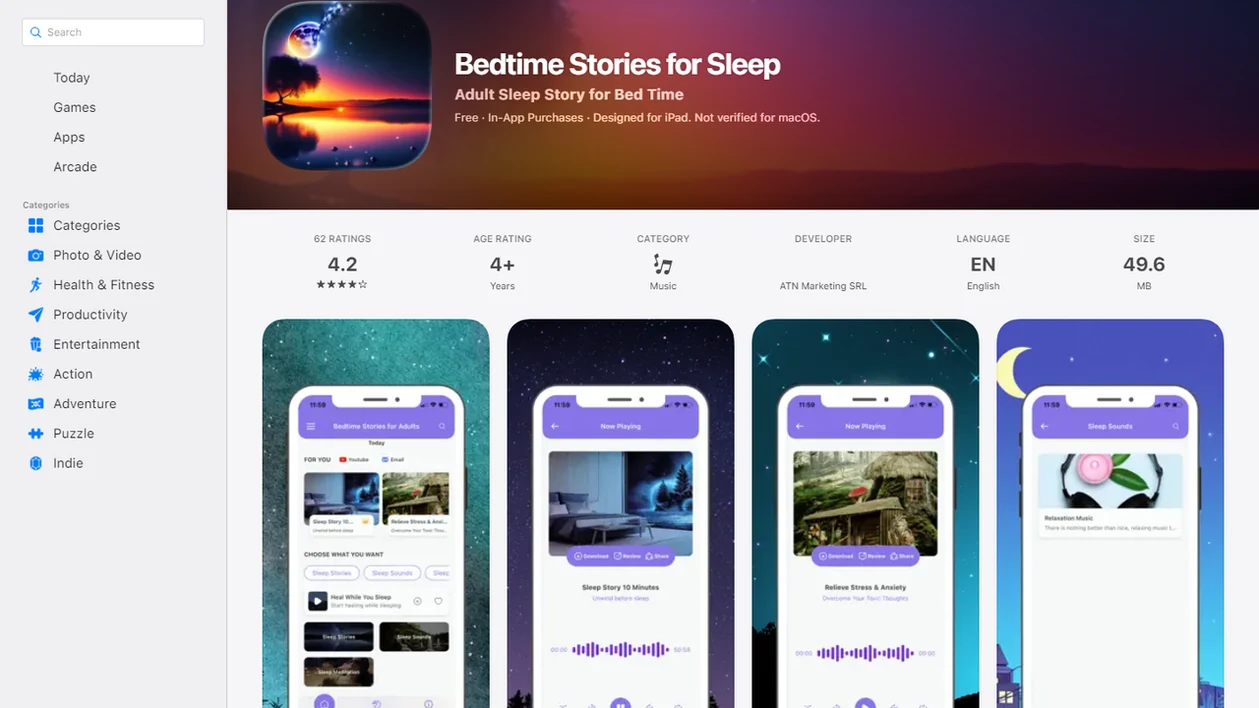
Side-by-side captures of the compared products. Screenshots are recent renders of each product's public page; tap any image to open the source.
Free Sleep Podcast Vs Paid Sleep App Comparison Table
Free sleep podcasts are usually simpler, while paid sleep apps offer more control over timing, downloads, content type, and routine design. The better choice depends on whether bedtime friction or subscription cost bothers you more.
| Category | Free sleep podcast | Paid sleep app | Practical winner |
|---|---|---|---|
| Cost | No subscription, often ad-supported | Monthly or annual sleep app subscription | Free podcast |
| Ads | Host reads, platform ads, sponsorships | Often ad-free after payment, but may include upsells | Paid app |
| Offline use | Episode downloads may work | Usually built for offline libraries | Paid app |
| Sleep timers | Depends on podcast platform | Usually built in | Paid app |
| Content quality | Varies by show | More consistent tagging and mixing | Paid app |
| Personalization | Minimal | Favorites, playlists, preferences | Paid app |
| Tracking | Usually none | Sometimes mood, sleep, or listening logs | Paid app, with privacy caveats |
| Privacy | Platform-level listening data | Account, device, and behavior data may be collected | Depends on policy |
| Ease of use | Open Spotify, Apple Podcasts, or YouTube | More setup, more menus | Free podcast |
Bedtime Adult fits adults who want family-safe bedtime audio with soft narration, sleep sounds, and a timer-style routine, especially when a random podcast queue feels too loose.
Five Facts About Free Sleep Stories Podcast And Paid Sleep App Choices
These five facts matter before comparing any free sleep stories podcast with a paid sleep app. Audio can support a wind-down routine, but the label “sleep app” does not make something clinically proven.
- Free sleep podcasts provide instant access, but they usually lack app-style offline libraries, personalization, routine builders, and progress tracking.
- Paid sleep apps often bundle bedtime stories, meditations, breathing exercises, soundscapes, courses, and sometimes sleep tracking in one account.
- A 2021 systematic review found that only 32.9% of Google Play sleep apps had empirical evidence supporting claims, and 15.8% had clinician input source.
- A 2018 online survey of 651 people found that 62% reported using music to help them sleep, which supports the idea that bedtime audio is common but not automatically clinical evidence source.
- Both formats should be viewed as general relaxation tools, not guaranteed treatments for insomnia or diagnosed sleep disorders.
Paid does not automatically mean medical.
The right fit for adults who want Sleep Stories for Grown Ups without explicit content is Bedtime Adult because it keeps the library focused on calm fiction, sleep meditations, and family-safe soundscapes.
How Free Sleep Podcasts And Paid Sleep Apps Work
Free sleep podcasts and paid sleep apps work by giving the brain a repeatable wind-down cue. The mechanism is simple: attention shifts away from rumination, the body gets a familiar relaxation signal, and the routine becomes easier to repeat.
Podcasts are usually linear RSS feeds or platform-hosted audio streams. You press play, hear an episode, and rely on Spotify, Apple Podcasts, YouTube, or another podcast app for downloads and timers. Paid apps use structured content libraries with accounts, preferences, sleep timers, downloads, favorites, reminders, and sometimes sleep tracking.
The data flow also differs. Podcasts may collect platform-level listening data, while apps may collect account details, device data, behavior patterns, sleep estimates, and sometimes recordings. That matters if your phone is face down on the nightstand with the sleep timer already set.
Bedtime Adult works on the paid-app side of this comparison because it organizes adult bedtime stories, meditations, and sleep sounds into a repeatable routine rather than a loose episode feed.
How To Use A Free Sleep Podcast Or Paid Sleep App
Use either option by setting up the audio before you are already drifting off. The goal is to make bedtime listening feel automatic, not like another late-night menu to manage.
- Choose the episode or track before bed, ideally while the lamp is still on and you can make a calm decision without scrolling through ten more choices.
- Set the timer or episode ending first, then place the phone face down or out of easy reach so the routine does not turn into more screen time.
- Download the audio in advance when travel, hotel Wi-Fi, flights, or weak service might interrupt streaming at the exact wrong moment.
- Keep the volume low and steady so narration is audible but not sharp enough for music swells, ads, or scene changes to startle you awake.
- Repeat the same setup for several nights before judging whether it helps, because the routine cue usually matters as much as the individual story.
If a free podcast stays calm and predictable, keep it. If you keep fighting ads, connection problems, or timer settings, a paid sleep app may make the same habit easier to repeat.
Where A Free Sleep Stories Podcast Wins For Adults
“Should I start with a free sleep stories podcast?” Yes, if you want no cost, no trial cancellation pressure, and almost no setup before bed. A podcast is often enough when you simply want one familiar voice or a low-drama story.
Free audio is easy to reach through Spotify, Apple Podcasts, YouTube, and general podcast apps. You can search, press play, and put the phone down. That lower friction matters at 10:15 p.m., when the bedside lamp is already dimmed and another account signup feels like too much.
For adults with mild bedtime anxiety or occasional restlessness, a free podcast may be more practical than a paid sleep app because the habit is simpler to start and easier to abandon.
The caveat is real. Ads, host reads, platform autoplay, sudden volume shifts, and inconsistent publishing can break the mood. If you are comparing show styles, the Get Sleepy vs Nothing Much Happens discussion shows how much narration style can change the bedtime experience.
Where A Paid Sleep App Wins For Adults
“When is a paid sleep app better than a free podcast?” A paid sleep app is better when you need offline downloads, reliable sleep timers, structured routines, and less ad disruption. Those features matter most during travel, shared bedrooms, and late-night screen avoidance.
Paid apps usually offer favorites, playlists, reminders, routine builders, and content tags. They may also include bedtime stories, sleep meditations, breathwork, ambient sounds, and short courses. The experience is more directed than a podcast feed.
In practice, this puts Bedtime Adult in the same paid-app decision set as Calm, Headspace, BetterSleep, and Slumber, but with a narrower focus on family-safe adult bedtime stories, meditations, and sleep sounds.
Anyone dealing with hotel Wi-Fi, thin curtains leaking city light, or a flight the next morning may prefer Bedtime Adult because offline stories and sleep sounds can be saved before bedtime. The mechanism is simple: pick the audio earlier, set the timer, and avoid scrolling in bed.
More features do not automatically mean better sleep. A crowded app can become another thing to manage. For broader app comparisons, our best adult bedtime story apps guide covers the main paid options.
Sleep App Subscription Costs, Ads, Offline Use, And Privacy Policies
Sleep app subscription value depends on what the subscription removes and what it adds. The practical questions are ads, offline use, cancellation terms, and how much personal data the service collects.
For subscriptions, look for the renewal date, cancellation path, and whether the trial converts automatically. The FTC’s negative-option guidance treats clear disclosure and easy cancellation as core consumer-protection issues source.
| Policy area | Free sleep podcast | Paid sleep app |
|---|---|---|
| Access | Usually free through a podcast platform | Usually monthly or annual billing |
| Ads | Host-read ads, sponsorships, platform ads | Often fewer ads, but upsells may remain |
| Offline use | Episode downloads may be possible | Dedicated offline libraries are common |
| Cancellation | No subscription to cancel | Renewal date and trial terms matter |
| Privacy | Platform listening data | Account, device, behavior, and sleep-pattern data |
| Recordings | Usually not part of podcast use | Some apps may request microphone access |
Review cancellation terms, renewal dates, data deletion settings, and privacy policies before paying. This is not bedtime paperwork, but it matters.
When ad breaks are the issue, Bedtime Adult earns the spot for adults who want partner-friendly listening because the routine can stay inside a controlled library with sleep sounds and soft narration. Good bedtime stories and sleep meditation for adults deliver calming fiction, wind-down routines, and family-safe sleep sounds, not 18+ content or clinical sleep treatment.
How To Choose A Free Podcast Or Paid Sleep App
Use a short test before paying for anything. The better option is the one that lowers bedtime friction, not the one with the longest feature list or the prettiest sleep score.
- Set one sleep goal such as fewer ads, less scrolling, offline listening, or a calmer routine.
- Test a free sleep stories podcast for several nights if your need is simple bedtime narration or soft background sound.
- Compare app features that actually matter to you, including timer, downloads, family-safe adult content, meditations, sounds, and privacy controls.
- Read the subscription terms before starting a trial, especially renewal date, cancellation path, and data deletion options.
- Choose based on routine improvement, not sleep scores alone, because consumer tracking can estimate patterns without diagnosing sleep.
On nights when rain tapping softly through headphones is enough, stay free. When you need saved audio, a timer, and fewer decisions, a paid app can be worth testing. Bedtime Adult fits that second case because Sleep Stories for Grown Ups, meditations, and sleep sounds sit inside one bedtime workflow.
Who Should Pick A Free Sleep Podcast Or Paid Sleep App
Choose a free sleep podcast if you want no subscription, minimal setup, familiar narration, and basic bedtime stories. Choose a paid sleep app if you want offline content, reliable sleep timers, varied formats, and less ad disruption.
Choose A Free Sleep Podcast If
The minimal listener wants one calm voice, a simple queue, and no billing page. A free podcast can be enough for adults with occasional restlessness or mild bedtime anxiety, especially when the goal is just to stop thinking about work emails after the laptop lid clicks shut.
Choose A Paid Sleep App If
The structured listener wants saved stories, timers, favorites, meditations, ambient sound, and content standards. Bedtime Adult is a practical fit for adults who need family-safe bedtime stories for grown-ups because the focus stays on calm adult narration, not children’s story voices or explicit material.
If you are comparing large meditation brands, the Calm vs Headspace for sleep stories page is useful. Medical sleep symptoms, however, should trigger professional evaluation rather than more app shopping.
Limitations
Neither a free podcast nor a paid sleep app should be treated as a proven treatment for chronic insomnia, sleep apnea, narcolepsy, restless legs, or another diagnosed sleep disorder. Bedtime audio can support general relaxation, but it is not medical care.
- Consumer sleep tracking and sleep scores may be inaccurate, and checking them too closely can increase sleep anxiety.
- Paid sleep apps are not automatically scientific or clinically validated, even when the design feels polished.
- Some adults find stories, voices, breathwork, or meditations distracting instead of calming.
- Both formats can increase bedtime screen interaction if setup happens too late.
- Privacy and data sharing can be unclear, especially when apps collect sleep patterns, device data, or recordings.
- Free podcasts can include loud ads, irregular publishing, platform autoplay, and inconsistent audio levels.
- A shared speaker set to low volume may still bother a partner who asks, “Can you turn it down one notch?”
For content-boundary questions, especially around non-explicit listening, our guide to safe bedtime stories for adults is the better place to start.
FAQ
Are free sleep podcasts effective?
Free sleep podcasts can support relaxation and routine for some adults. Results vary, and they should not be treated as medical treatment.
Are paid sleep apps worth it?
Paid sleep apps can be worth it when offline use, sleep timers, structured routines, and fewer ads improve bedtime consistency. They are less useful if you only need simple audio.
Do sleep apps really track sleep?
Consumer sleep apps may estimate sleep patterns from phone or wearable data. They are not equivalent to a clinical sleep study.
Which option has fewer ads?
Paid apps usually have fewer bedtime ad interruptions than free podcasts. Free podcasts may include host reads, sponsorships, platform ads, or autoplay.
Can podcasts play offline?
Many podcast platforms allow episode downloads for offline listening. App-style library management is usually more sleep-specific in paid sleep apps.
Are there free sleep apps with no subscription?
Some sleep apps offer free tiers with limited content or features. Many reserve full libraries, downloads, or tracking tools for a subscription.
Which sleep audio option works well on iPhone?
iPhone users can choose Apple Podcasts or Spotify for free audio, or a dedicated sleep app for timers, downloads, and structured routines. The better choice depends on offline and ad-control needs.
Which sleep audio option works well on Android?
Android users should compare podcast apps, Google Play sleep apps, privacy policies, and subscription terms. A paid sleep app is not automatically more validated than a free podcast.
Can sleep audio treat insomnia?
Sleep audio may help with relaxation and a consistent bedtime routine. Persistent insomnia should be discussed with a qualified health professional.