
Racing Thoughts at Bedtime: Why Your Mind Feels Louder at Night
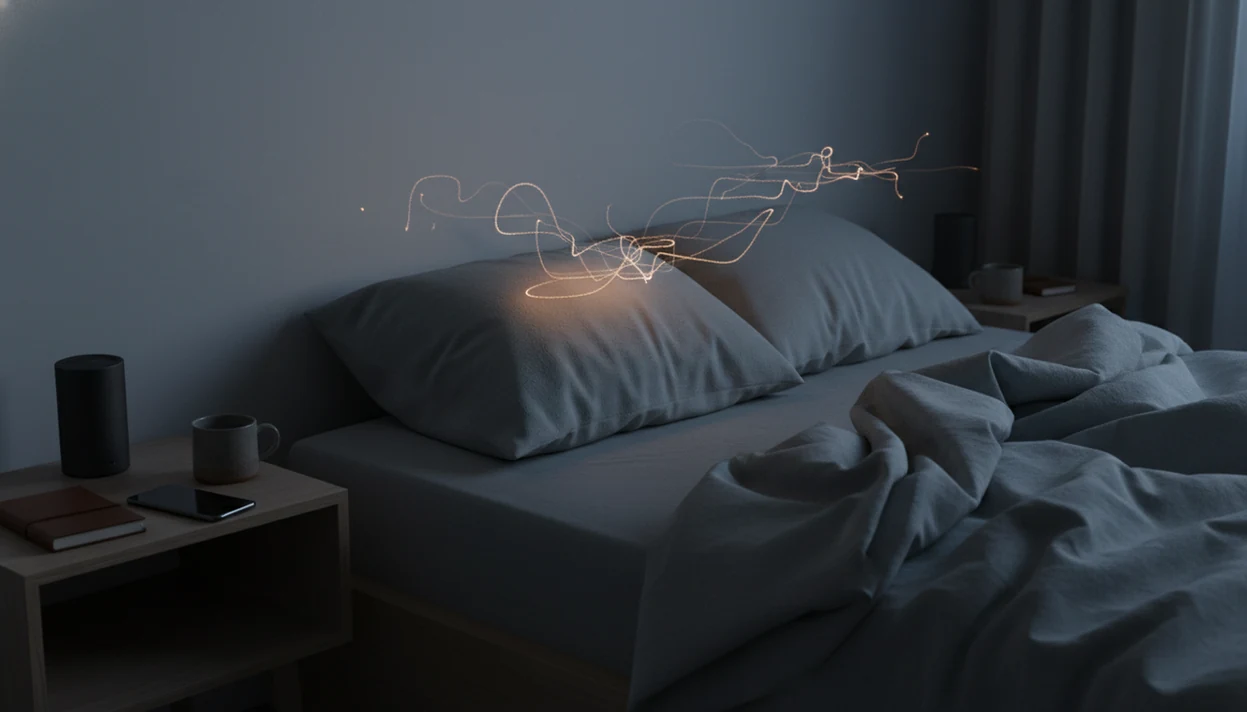
Racing thoughts at bedtime feel louder because the day gets quiet, distractions drop away, and your brain may finally start processing stress, plans, or unresolved worries. A calm wind-down routine, including gentle audio when it is not overstimulating, can give your attention a softer place to land.
Definition: Racing thoughts at bedtime are fast, repetitive, or intrusive bedtime thoughts that make it hard to shift from daytime problem-solving into sleep.
TL;DR
- A mind racing at night is common during stress, anxiety, life changes, and some mental health conditions, but it does not automatically mean something is seriously wrong.
- The most helpful approach is usually not forcing your mind to go blank, but redirecting it with a predictable wind-down routine, breathing, relaxation, or calm audio.
- If racing thoughts are intense, persistent, linked to mood swings, trauma, panic, or severe insomnia, self-help tools are not enough and professional support may be needed.
Racing Thoughts at Bedtime Definition for a Mind That Will Not Shut Off
Racing thoughts at bedtime are fast, repetitive, or intrusive bedtime thoughts that make it hard to shift from daytime problem-solving into sleep. They can feel like replaying one awkward sentence from a meeting, planning tomorrow in too much detail, or jumping from a bill to a memory to a random health worry.
People often describe this as a mind racing at night, or as “I can’t stop thinking at night” even when the body feels tired. The content changes. The loop often does not.
Racing bedtime thoughts can happen during ordinary stress, big life changes, anxiety, depression, ADHD, or bipolar disorder. In insomnia prevalence reviews indexed by PubMed, roughly 30% of adults report insomnia symptoms and about 10% meet criteria for chronic insomnia, depending on the definition used: https://pubmed.ncbi.nlm.nih.gov/17682677/. That makes the problem common, but still worth taking seriously when it keeps repeating.
Five Facts About Racing Thoughts at Bedtime and Nighttime Worry
- Racing thoughts are linked with several conditions, but they are not a diagnosis by themselves. Stress, anxiety, depression, ADHD, and bipolar disorder can all include fast or repetitive thinking.
- Night makes thoughts feel louder because outside input drops. When the room is dark and the phone is face down, the brain has fewer things competing with worry.
- A 30- to 60-minute wind-down routine can lower stimulation before bed. Clinicians typically recommend consistent sleep hygiene basics, including dimmer light, less stimulating media, and a steady sleep-wake schedule.
- Slow breathing, progressive muscle relaxation, mindfulness, and guided meditation can reduce arousal. These practices give the nervous system a repeated cue to downshift.
- Calm audio can work as a non-stimulating attention anchor when chosen carefully. Soft narration, brown noise, or distant train ambience may be easier to follow than silence for some adults.
For perspective, the National Institute of Mental Health estimates lifetime generalized anxiety disorder prevalence among U.S. adults at about 5.7% and 12-month bipolar I disorder prevalence at about 1.0%: https://www.nimh.nih.gov/health/statistics/generalized-anxiety-disorder and https://www.nimh.nih.gov/health/statistics/bipolar-disorder.
Brain and Body Mechanisms Behind Racing Thoughts at Bedtime
How racing thoughts at bedtime work: the brain moves from external task attention into quiet internal awareness, and unfinished concerns become easier to notice. Stress arousal keeps the body in a light “ready” state, with higher alertness than sleep needs.
Problem-solving mode is useful at 3 p.m. It is less useful under a duvet.
Several mechanisms can stack together. Rumination loops repeat the same concern without resolving it. Conditioned wakefulness can teach the brain that bed is a place for planning, checking, and rehearsing. Sleep loss then makes emotional regulation weaker the next day, so the next night may feel harder.
The CDC reports that many U.S. adults get less than the recommended seven hours of sleep in a 24-hour period: https://www.cdc.gov/sleep/data-research/facts-stats/adults-sleep-facts-and-stats.html. Meta-analytic research also links insomnia with later anxiety and depression risk, which is one reason repeated sleeplessness deserves attention: https://pubmed.ncbi.nlm.nih.gov/30537570/.
Why a Mind Racing at Night Feels Worse Than Daytime Worry
Why does my mind race more at night? Bedtime removes the daytime noise that was holding your attention elsewhere. Darkness, silence, fatigue, and fewer interruptions can make an ordinary concern feel sharper.
Timing matters. If the first quiet moment of the day happens after the bedside lamp goes off, your brain may use bed as the planning room. Tomorrow’s uncertainty gets pulled forward. The meeting notes left on the kitchen table suddenly feel urgent again.
A worry window earlier in the evening can help move problem-solving out of bed. For some adults, a structured 30-minute bedtime routine after work is easier than trying to improvise calm when the room is already dark.
For people who replay tasks at lights-out, writing the next three actions before bed is often easier than trying to mentally finish the whole week.
Common Bedtime Thoughts That Keep Adults Awake
Common bedtime thoughts vary in topic, but many follow the same loop: attention, arousal, more thinking. The brain notices a concern, the body becomes more alert, and alertness makes the concern feel more important.
- Work Replay: You re-hear a conversation, edit what you said, or imagine what someone meant. The scene may be small, but the repetition keeps it active.
- Tomorrow List: You start arranging errands, emails, childcare, bills, and appointments. Two pillows arranged around one phone can become a whole command center.
- Relationship Loop: You scan a text, tone, or silence for hidden meaning. The mind wants certainty where none may be available at midnight.
- Health What-If: A body sensation turns into a chain of possibilities. This can feel especially sticky when the room is quiet.
- Random Thought Cascade: One unrelated thought triggers another. Not dramatic. Just relentless.
Racing Thoughts at Bedtime vs Anxiety, Insomnia, and Bipolar Symptoms
Racing thoughts alone do not diagnose anxiety, insomnia, bipolar disorder, or any other condition. They are a symptom pattern, and the surrounding features matter.
| Pattern | What it can feel like | When to pay closer attention |
|---|---|---|
| Everyday racing thoughts | Replaying the day, planning tomorrow, or mental clutter during stress | It improves when stress settles or routines become steadier |
| Anxiety-related worry | Repeated “what if” thoughts that feel hard to control | Worry spreads across many topics and affects daily life |
| Insomnia | Trouble falling asleep, staying asleep, or waking too early | The pattern lasts weeks and creates daytime impairment |
| Bipolar-related racing thoughts | Fast thoughts with unusually high energy or reduced need for sleep | Risky behavior, impulsivity, or major mood shifts appear |
Generalized anxiety disorder affects about 5.7% of U.S. adults across a lifetime, while bipolar I disorder affects about 1.0% in a 12-month period. Seek professional support if racing thoughts come with decreased need for sleep, severe depression, panic, trauma symptoms, risky behavior, or thoughts of self-harm.
Common Myths About Bedtime Thoughts and Sleep Fixes
Several common sleep fixes can backfire when your brain is already alert.
Myth: Racing thoughts always mean serious mental illness. They can occur with clinical conditions, but they also happen during deadlines, grief, parenting stress, travel, or plain overload.
Myth: You must clear your mind completely to sleep. Most people do better by redirecting attention than by trying to force silence. A blank mind is not the entry fee.
Myth: Scrolling your phone in bed helps you unwind. Bright screens, fast clips, and emotionally loaded posts can keep the brain in alert mode. The thumb hovering over airplane mode is often the better signal.
Myth: Alcohol reliably fixes a racing mind. It may feel sedating at first, but alcohol can disrupt sleep architecture, increase awakenings, and worsen sleep quality later in the night: https://www.niaaa.nih.gov/publications/alcohol-and-sleep.
The better strategy is usually lowering stimulation and gently redirecting attention. A bedtime routine timeline can make that shift more repeatable.
Related Concepts for Racing Thoughts at Bedtime
Related concepts help separate ordinary nighttime mental noise from patterns that may need more support. Racing thoughts can overlap with rumination, worry, intrusive thoughts, or simple bedtime mental clutter, but those words do not all mean the same thing.
Rumination is replaying the past, often with “why did I do that?” energy. Worry points forward, rehearsing what might go wrong tomorrow. Intrusive thoughts are unwanted mental images or ideas that pop in and feel disturbing or sticky. Bedtime mental clutter is broader: tasks, fragments, songs, plans, and half-finished thoughts piling up when the room goes quiet.
Insomnia describes ongoing difficulty sleeping, anxiety often centers on threat and uncertainty, ADHD may involve busy attention and delayed wind-down, and bipolar contexts can include racing thoughts with high energy or reduced need for sleep. None of that diagnoses you from one bad night.
A few adjacent tools are worth naming:
- Use sleep hygiene as the basic setup: steady timing, lower light, less stimulation.
- Notice conditioned arousal if bed has become linked with alert thinking.
- Try relaxation training, such as breathing, muscle release, or meditation.
- Consider CBT-I for chronic insomnia, especially when routines alone are not enough.
Calm Audio for Racing Thoughts at Bedtime Without Overstimulation
Calm audio can give racing thoughts a low-effort place to land, but it is not a cure for anxiety, insomnia, trauma, or mood disorders. It works best when the audio is predictable enough that the brain does not need to chase it.
Helpful traits include gentle pacing, soft voices, low emotional intensity, sleep sounds, guided meditation, and simple story arcs. Avoid suspenseful podcasts, dramatic true crime, loud comedy, or any story that makes you wait for a reveal. No plot twist jolting the room.
Bedtime stories and sleep meditation for adults can offer calming fiction, wind-down routines, and sleep sounds, family-safe, not 18+ content or clinical treatment. Bedtime Adult is a bedtime stories for adults app that offers calming fiction, sleep meditations, and sleep sounds for grown-ups. Tools like Bedtime Adult fit adults who want soft narration without children’s voices, erotic framing, or medical promises. The Sleep Stories for Grown Ups category is most useful when it stays low-drama.
Daytime Habits for Can't-Stop-Thinking-at-Night Patterns
Nighttime racing thoughts are often shaped earlier than bedtime. If the day has no pause for processing, the brain may claim that time after lights-out.
How to use a daytime routine for racing thoughts:
- Schedule worry time in the afternoon or early evening, then write the main concern and one next step.
- Move tomorrow’s list outside the bedroom before your wind-down starts.
- Set a caffeine cutoff that fits your body, especially if you are sensitive after lunch.
- Get morning light and some daytime movement to support the body clock.
- Lower stimulation for 30 to 60 minutes with dim lights, slower tasks, and no fast-paced screens.
- Repeat the same cue most nights, such as soft rain audio or a short body scan.
If you need a shorter version, a 10-minute bedtime routine for adults can still create a useful boundary. For people building the habit gradually, a 2 weeks bedtime routine plan may feel less intimidating than a full overhaul.
Limitations
Calm routines can help many people, but they have real limits. Use them as support, not as a substitute for care when symptoms are severe or persistent.
- Calm audio, bedtime stories, and sleep meditations are aids, not cures.
- Racing thoughts linked to untreated anxiety, depression, bipolar disorder, trauma, or severe insomnia may need professional care.
- Some people are sound-sensitive and sleep better with silence, earplugs, or a quieter room.
- Results from relaxation routines are usually gradual, not instant.
- Stimulating audio can make bedtime thoughts worse, especially suspense, loud voices, or emotionally charged content.
- CBT-I or clinical treatment may be appropriate for chronic insomnia.
- If racing thoughts come with decreased need for sleep, high energy, risky behavior, or major mood changes, contact a qualified clinician.
- If you have thoughts of self-harm or feel unsafe, seek urgent help now through local emergency services or a crisis line.
A phone turned face down with the sleep timer set is useful only if the content keeps the room calm.
FAQ
Why do my thoughts race at night?
Thoughts race at night because quiet, darkness, fatigue, and fewer distractions make stress and unfinished concerns more noticeable. Your brain may also be processing issues that had no space during the day.
How can I stop racing thoughts at bedtime?
Try redirecting attention with a predictable wind-down routine, slow breathing, journaling, relaxation, or calm audio. Forcing your mind to go blank often creates more pressure.
Do racing thoughts at bedtime mean I have anxiety?
Racing thoughts can occur with anxiety, but they can also come from stress, sleep loss, ADHD, depression, bipolar disorder, or temporary life changes. A clinician can help if symptoms are intense or persistent.
Can insomnia cause racing thoughts?
Insomnia and racing thoughts can reinforce each other. Poor sleep can make emotional regulation harder, and anxious rumination can make sleep harder.
Can sleep audio help with racing thoughts?
Gentle, predictable audio can help some people by giving the mind a calm focus. Bedtime Adult is one option for adults who want family-safe stories, meditations, and sleep sounds.
What kind of audio is best for sleep?
Soft, slow, low-stakes bedtime stories, meditations, and sleep sounds are usually better than suspenseful or stimulating content. Choose audio that you would not mind missing because you fell asleep.
Should I journal before bed if my mind will not shut off?
Writing worries or tomorrow’s tasks before getting into bed can move problem-solving out of the bedroom. Keep it brief and practical rather than turning it into a long analysis session.
Can using my phone in bed make racing thoughts worse?
Yes, bright screens and stimulating content can keep the brain alert and increase mental chatter. If you use a phone for audio, dim it, set the timer, and place it face down.
When should I get help for racing thoughts at bedtime?
Seek professional help if racing thoughts come with chronic insomnia, severe anxiety, depression, mood swings, trauma symptoms, panic, risky behavior, or thoughts of self-harm. Self-help tools are not enough when safety is involved.